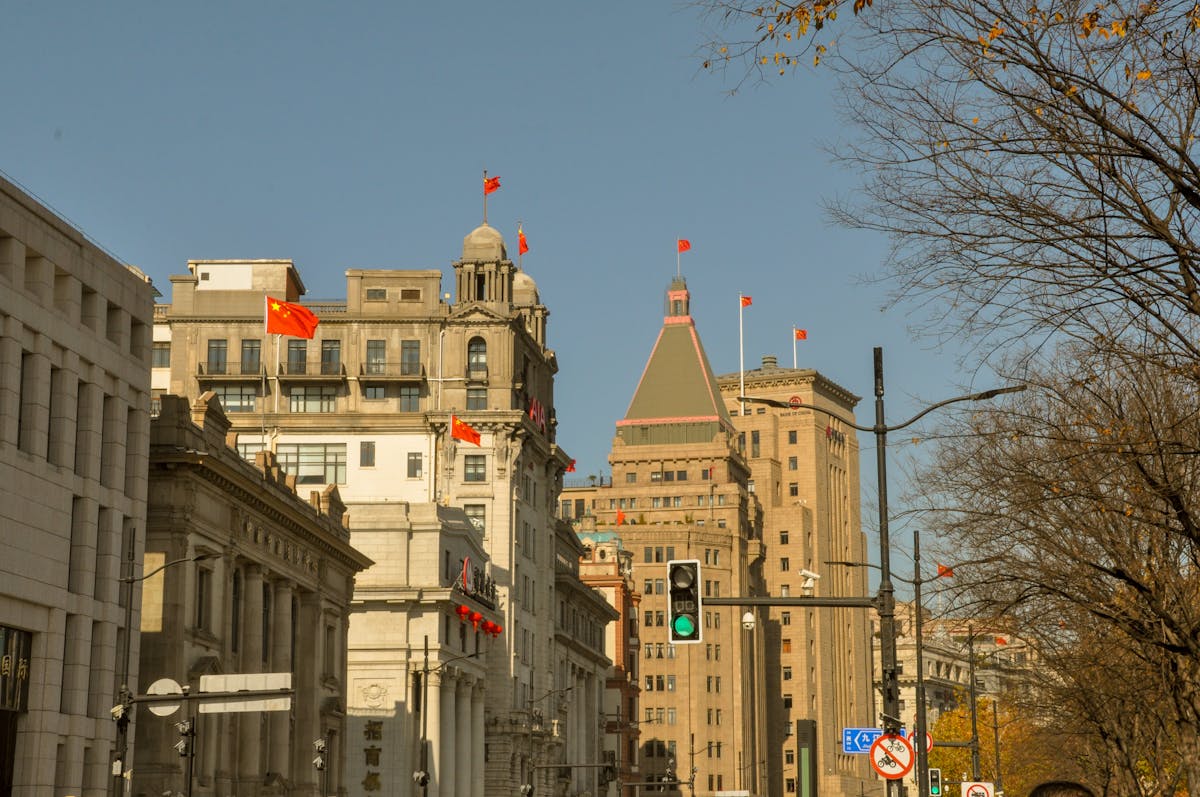
Walk north along Zhongshan East No. 1 Road on a winter evening at 17:45 and the sequence reveals itself: a former bank, a former trading house, another former bank, a former hotel — fifty-two of them in 1.5 kilometres, each in a different style, none of them Chinese in origin. This is the Bund, a strip of Huangpu district riverfront that for roughly seventy years held the densest concentration of foreign capital anywhere in Asia. Most of the buildings still standing went up between 1880 and 1937.
The name itself is borrowed. "Bund" comes from the Hindi-Urdu word band, meaning embankment — vocabulary brought across from British India in the 1840s, when the original mudbank was reclaimed and stabilised. In Mandarin the place is Waitan (外滩, "outer bank"); both labels usually appear together on tourist maps.
Geography and the river
Two boundaries fix the Bund. Yan'an East Road (formerly Edward VII Avenue) marks the southern end, near the meridian gate of the old Chinese walled city. Suzhou Creek and the Garden Bridge — a steel through-truss erected in 1907 — close the northern end. Between them, 1.5 km of promenade raised about three metres above street level on a flood embankment that doubles as a public viewing terrace.
Originally this was tidal mud. Until 1843, when the Treaty of Nanking opened Shanghai to foreign trade, no permanent structure stood here. By 1900 it was the financial centre of the Far East — and the buildings that survive today are mostly the second or third generation, replacing earlier two-storey godowns with grander stone fronts as the firms behind them grew rich.
Reading the architecture, south to north
Fifty-two structures of historical interest run between Yan'an East Road and Suzhou Creek. They span Beaux-Arts, Gothic, Romanesque, Baroque, Neo-Classical, Renaissance and Art Deco — most assembled by Shanghai-based architects working in catalogue idioms borrowed from London, New York and Paris. A few of the principal ones:
- No. 12 — the former HSBC Building (1923, Palmer & Turner). Greek-revival columns, a central dome, twelve storeys of granite. At completion it was reported to be the second-largest bank building in the world after the Bank of England's headquarters. Octagonal lobby ceiling mosaics depicting the eight cities where HSBC then operated were rediscovered behind plaster panels in 1997 and restored.
- No. 13 — the Customs House (1927, also Palmer & Turner). A clock tower modelled openly on Westminster's Big Ben, with a chiming Westminster quarters mechanism that played until 1966 and was restored in 2003.
- No. 20 — the Cathay Hotel, now Peace Hotel (1929, Palmer & Turner for Sir Victor Sassoon). Art Deco at its most confident, with a green pyramidal copper roof that has oxidised into the building's signature feature.
- No. 23 — Bank of China (1937, Lu Qianshou and Palmer & Turner). The only building on the row co-designed by a Chinese architect, with a stepped roofline drawn from Ming-dynasty precedent. Construction stopped during the Japanese occupation and was completed only after 1945.
- No. 2 — the former Shanghai Club (1910, Tarrant and Atkinson). At opening the bar inside was reportedly the longest in the world at 33.6 metres. The building now contains the Waldorf Astoria's lobby restaurant.
Each building carries a small bilingual bronze plaque at street level naming its original tenant, the architect, the year of completion and the architectural style — installed by the Huangpu district government in 1996 as part of the row's listing as a national protected heritage zone.
Hours and timing
The promenade itself never closes — public access to the raised walkway is unrestricted at all hours, and the buildings are illuminated nightly from sunset until 22:00 (extended to 23:00 on Friday and Saturday).
Dusk is the recommended window. In winter that means roughly 17:30 to 19:00; in summer, 18:30 to 20:00. Two things happen at once during these intervals — western façades hold the last of the daylight while LED towers of Pudong opposite begin their lit cycle. Photographers refer to it as the twenty-minute overlap, and the upper terrace fills accordingly.
A note on crowds
The Bund draws around 50 million visits a year. Weekends, Chinese public holidays and the Spring Festival period (late January through mid-February) push densities to the level where the upper terrace is one-way only and traffic is policed at Nanjing Road junction. Weekday mornings before 09:00 and weekday afternoons between 14:00 and 16:00 are noticeably calmer.
What's across the river
Looking east across roughly 600 metres of water sits Lujiazui, the Pudong financial district built almost entirely after 1990. Three towers dominate the skyline — Oriental Pearl (1994, 468 m), Jin Mao (1999, 421 m) and the Shanghai World Financial Center (2008, 492 m), with Shanghai Tower (632 m) standing behind them as the second-tallest building in the world. A quarter-mile of stone Beaux-Arts on one side, a forest of post-1990 glass on the other.
The contrast is the point. Two centuries of capital, photographed in a single frame, separated by 600 metres of brown river.
For more on the towers themselves, see the Pudong skyline entry.
Practical access
Metro is the simplest route in. Line 2 (the green line, also serving Pudong airport) and Line 10 (the purple line) both stop at East Nanjing Road station (南京东路), from which exit 1 or exit 2 leads onto Nanjing East Road; a five-minute walk east brings the river into view at the Chen Yi Square junction. Line 10 also stops at Yu Garden station, useful for visitors combining the Bund with the old town to the south.
By taxi or DiDi, ask for "Waitan" (外滩) or specifically for the Chen Yi Square drop-off. Note that Zhongshan East No. 1 Road runs one-way northbound for most of its length, so southbound taxis will set down on the western side of the road and require a pedestrian underpass to reach the waterfront.
Onward connections are covered in getting around Shanghai, and arrivals from Pudong airport in PVG to central Shanghai.
On the water itself
Several operators run cruise boats from embarkation points along the Bund and at the Pearl Dock on the Pudong side. Standard one-hour Huangpu River cruises cost ¥120–150 depending on seating tier, with departures roughly every 30 minutes between 11:00 and 21:30. The route runs upriver to the Yangpu Bridge and back — a different angle on the same architecture. Tickets are sold at booths near the Chen Yi Square steps and at Shiliupu pier 800 metres south.
Further reading: Britannica's Shanghai entry on the row's commercial history, and the Huangpu district tourism portal at meet-in-shanghai.net.