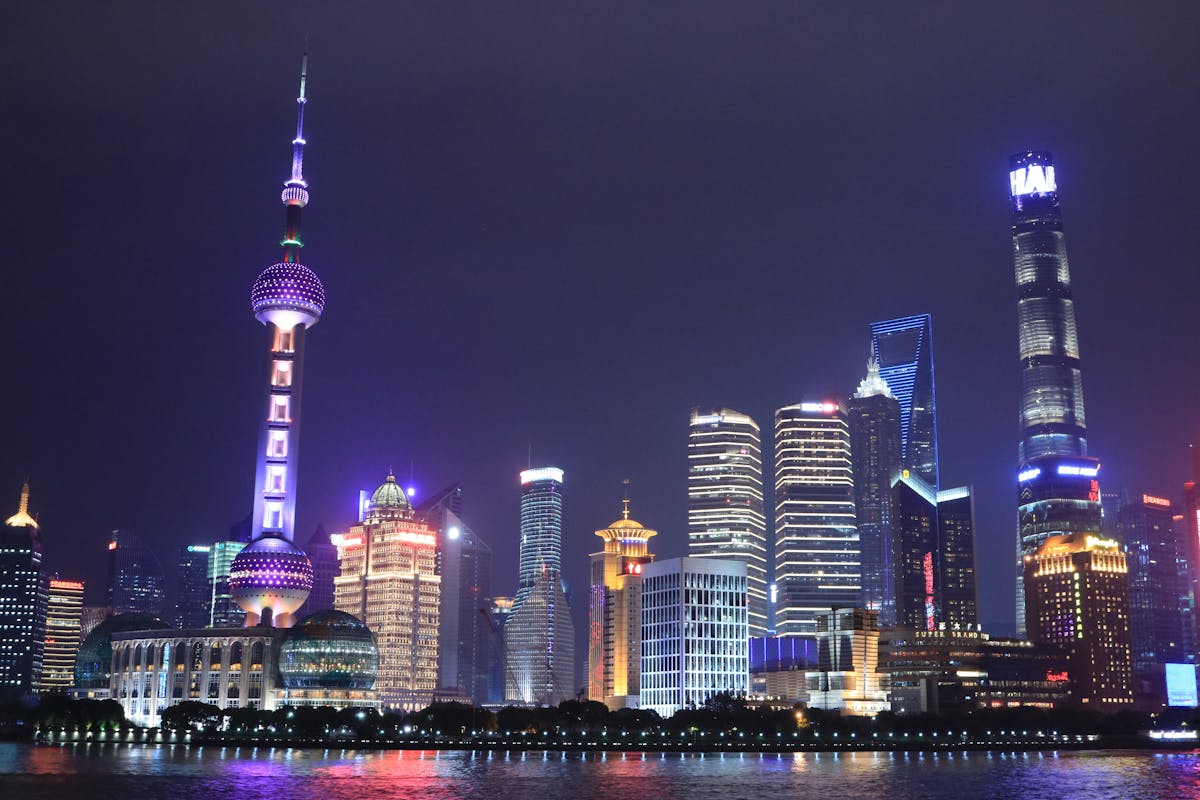
Lujiazui in 1990 was farmland and warehouses on a bend of the Huangpu River. That year the central government designated Pudong a special development zone, opening the eastern bank to state-directed construction that took thirty-five years to produce the cluster now visible from any pavement on the Bund. Three of those buildings — Jin Mao Tower (1999), Shanghai World Financial Center (2008), and Shanghai Tower (2015) — share a triangular plot of roughly six hectares and form, after the Hong Kong CBD, the densest concentration of supertall skyscrapers anywhere.
A fourth building, the Oriental Pearl TV Tower, sits a short walk north on the riverfront. At 468 m it predates the trio (1995) and was the city's tallest structure for thirteen years before SWFC overtook it.
Three towers, one block
Walked at street level, the cluster is bewildering — a pedestrian crosses Century Avenue and looks up to find the world's fourth-tallest building leaning over a small plaza of food carts and dry-cleaning shops. All three towers sit within a five-minute walk of Lujiazui Metro station (Line 2), with an elevated pedestrian ring road connecting them and the riverfront promenade. Most visitors who come for the view ascend exactly one of the three.
Together the three contain roughly 2.5 million square metres of floor space — offices, hotels, retail podiums, observation levels. None residential.
Shanghai Tower: the tallest one
At 632 m and 128 floors, Shanghai Tower opened in 2015 and remains China's tallest building and the world's fourth-tallest. Designed by Gensler, it twists 120 degrees between base and crown — a form chosen partly to reduce wind loading. A double-skin glass façade encloses nine stacked atriums up the height of the tower, an arrangement borrowed from low-rise buildings and unusual at this scale.
Visitors enter via a basement-level ticket lobby. A single elevator run to the floor-118 observation deck (552 m) takes about 55 seconds, on Mitsubishi-supplied lifts running at 20.5 m/s — among the fastest in commercial service. Tickets are ¥180 off-peak and ¥220 peak, with online booking required through shanghaitower.com.cn; same-day walk-up tickets sell out on weekends.
Practical note
Floor 118 is the main observation level, fully enclosed. Floor 121 is sometimes opened as an outdoor terrace at extra cost (¥40 supplement) but only in clear weather. Lobby staff will confirm which decks are open on the day before any payment is taken.
World Financial Center: the bottle opener
Shanghai World Financial Center opened in 2008 to a design by Kohn Pedersen Fox, and was briefly the world's second-tallest building. At 492 m and 101 floors, it is best known for the trapezoidal cut at the crown — locally nicknamed 开瓶器, kāipíngqì, "the bottle opener." The original design called for a circular aperture; the developer altered it during construction to a trapezoid, partly for wind pressure, partly to avoid the rising-sun motif.
Three observation areas are open: floor 94 (¥120, lower deck), floor 97 (¥150, open-air bridge across the aperture), floor 100 (¥180, "Sky Walk" with a glass floor at 474 m). Park Hyatt occupies floors 79 to 93 — for many years the highest hotel in the world by floor level. Tickets on swfc-shanghai.com.
Jin Mao Tower: the first of the cluster
Jin Mao came first. It opened in 1999 — the same year Pudong's airport became operational — and at 421 m it was for nine years mainland China's tallest building. Designed by Skidmore, Owings & Merrill (SOM), the form is octagonal in plan, drawing on the symbolism of eight (八, bā), considered auspicious in Chinese tradition. Eighty-eight floors, eight setbacks, eight-sided footprint.
Inside, Grand Hyatt Shanghai occupies floors 54 to 87, organised around an atrium that drops 30 floors as a single open shaft. Observation on floor 88 is ¥120, accessed separately at the basement entrance off Century Avenue. Of the three, Jin Mao has the shortest queues and the most settled feel — a fixture of the skyline now for a quarter-century. Details on jinmao88.com.
Choosing a deck
For a single ascent: height, view direction, queue.
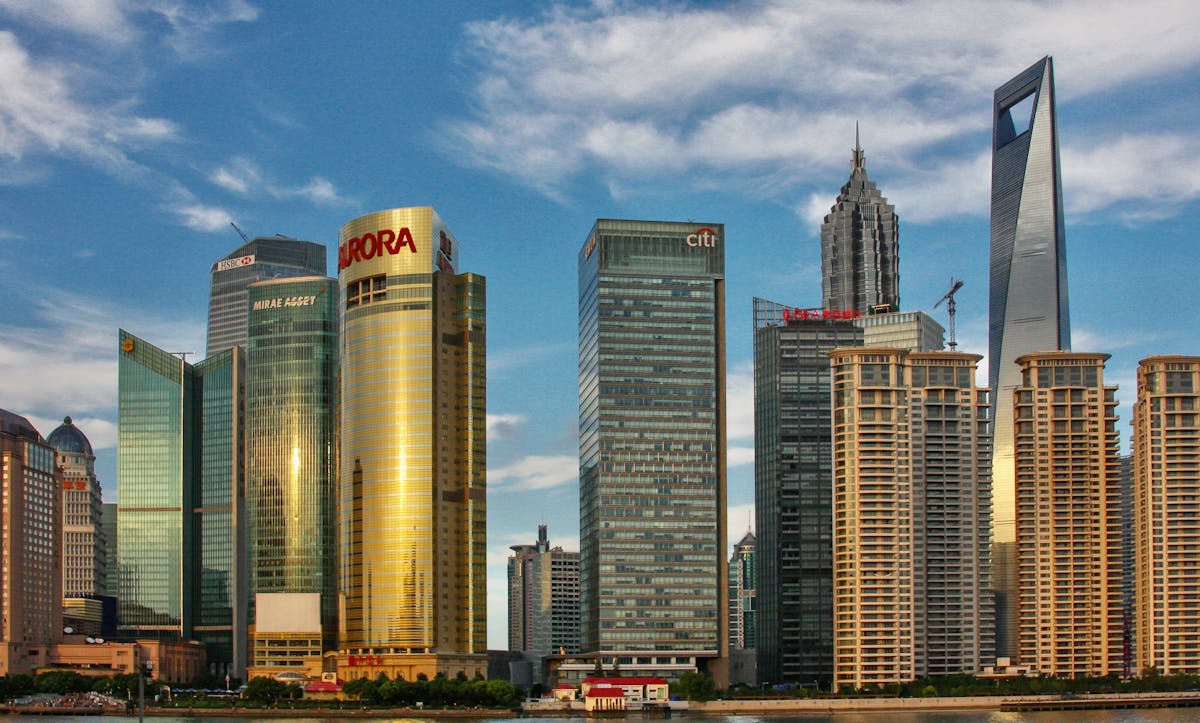
Shanghai Tower is the highest and newest, with a fully enclosed deck and strong crowd-management infrastructure. Its views look out in all four directions but are noticeably distant from the river — visitors are 552 m up and roughly 700 m from the Bund, so the historical waterfront reads as a thin band rather than the dominant feature. SWFC, lower and closer to the river, gives a more legible view of the Huangpu, with Shanghai Tower rising directly to the north as a foreground element. Jin Mao's deck is lowest and most central within the cluster, with both supertalls visible from one window.
| Tower | Deck height | Price | Best for |
|---|---|---|---|
| Shanghai Tower | 552 m (Fl. 118) | ¥180–220 | Maximum height, full panoramic, newest infrastructure |
| SWFC Sky Walk | 474 m (Fl. 100) | ¥180 | Glass floor, river view, two supertalls visible |
| SWFC bridge | 439 m (Fl. 97) | ¥150 | Outdoor air, the bottle-opener aperture overhead |
| Jin Mao | 340 m (Fl. 88) | ¥120 | Cluster centre, both neighbours framed |
| Oriental Pearl | 263 m (sphere) | ¥160 | Riverside position, retro 1995 character |
Late afternoon is the optimum slot — arriving around 16:30 to 17:00 puts a visitor on the deck for daylight, dusk, and the night transition over a 60-to-90-minute stay. Queues build sharply on Friday and Saturday evenings; weekday afternoons stay manageable.
Where to view from
Most photographs of the Pudong skyline are taken not from inside any tower but from across the river — specifically from the Bund promenade between Nanjing Road and Yan'an Road, where a raised walkway built in 2010 lifts pedestrians above traffic. Full cluster framed at 800 m across the Huangpu; evening lighting at sunset; scale reads more clearly from outside than within.
Two other vantage points. Shanghai Tower's deck looks down on its neighbours — the only place to see SWFC and Jin Mao from above. And Binjiang Avenue promenade, on the Pudong bank directly below the cluster, gives a worm's-eye view: three buildings rising together from one foreground.
The most photographed view in Shanghai is the Pudong skyline from the Bund — and at no point in twenty years has it stayed the same for more than four.
For the Bund itself see a separate entry; airport access in Pudong airport transfer; metro routing in getting around Shanghai.