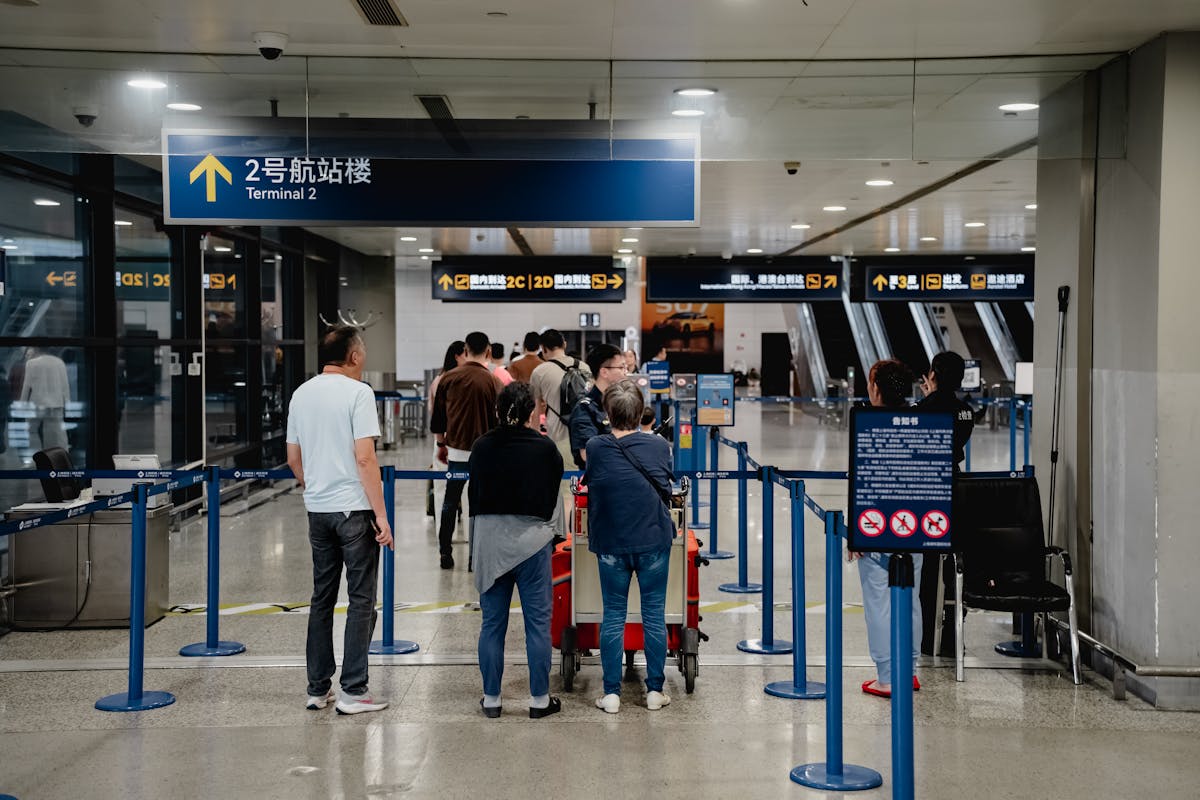
Pudong International Airport (PVG) opened in 1999 to take pressure off the older Hongqiao airport on Shanghai's western edge. It now handles roughly 65 to 75 million passengers a year across two terminals, and is the primary international gateway to the city — most long-haul flights from Europe, North America and Australia land here, while domestic and regional flights are split between PVG and Hongqiao. Built on reclaimed coastal land roughly 30 kilometres east of the Bund, PVG presents every arriving traveller with the same first practical question: how to cover those thirty kilometres.
There are five sensible answers, and the choice between them matters more than the equivalent choice at most major airports — because the gap between fastest and cheapest at PVG is unusually wide.
The geography in one line
PVG to the Bund is 30 km, mostly along the elevated S1 expressway and the underground Metro Line 2 corridor. Five practical options split along two axes: speed (Maglev fastest, taxi during heavy traffic slowest) and cost (Metro cheapest at ¥7, pre-booked sedan at ¥250–450 most expensive). Distance is fixed.
What varies is how the route is covered, and what level of friction is involved at each end.
Maglev: the seven-minute leg
The Shanghai Maglev remains the only commercial high-speed maglev line in the world. It runs from PVG terminal 1/2 station directly to Longyang Road station in eastern Pudong, a distance of 30 km, in seven minutes flat. Top speed during the run is 300 km/h on most departures, with a few daily peak-speed runs at 431 km/h marked in red on the timetable. A standard one-way ticket is ¥50, or ¥40 with a same-day boarding pass.
What it doesn't do is end at central Shanghai. Longyang Road is a Metro interchange in eastern Pudong, from which most travellers transfer to Metro Line 2, 7 or 16 to reach their actual destination. Total journey time to People's Square comes to roughly 25 minutes (7 min Maglev + 5 min walking transfer + 13 min Metro), at a cost of ¥54. To Lujiazui in central Pudong it's similar. For anywhere in Puxi west of People's Square, the time advantage over a direct Metro Line 2 ride starts to compress.
The Maglev is, in essence, a 30-kilometre prelude rather than a complete journey on its own.
Practical note
The Maglev runs 06:45 to 21:40 with departures every 15–20 minutes during the day. Late-night arrivals after 21:40 cannot use it. Luggage handling at PVG is straightforward — the station is on the same level as the airport's south concourse, no major lifts or stairs.
Metro Line 2: the cheapest route
Metro Line 2 runs directly from PVG terminals 1 and 2 (the line uses a single shared station beneath the airport) all the way across central Shanghai, through Lujiazui, People's Square, Jing'an Temple, and onward to the western suburbs and Hongqiao airport on the other side of the city. The total journey from PVG to People's Square is 60 to 70 minutes and costs ¥7. Trains run every 6–10 minutes during the day and every 12–15 minutes in late evening.
One detail that catches first-time visitors: Line 2 from PVG is split into two segments. The original section ran only as far as Guanglan Road, and the airport extension is a separate train that you must transfer to mid-journey. There is no direct PVG-to-Lujiazui train; everyone changes at Guanglan Road, which is a single cross-platform transfer of about three minutes. The current Shanghai Metro service charts and station displays make this clear, but the first 30 seconds at Guanglan Road can feel disorienting if you're not expecting it.
Tickets can be bought from machines at the station (English interface available, accepts Chinese debit cards, ¥10 and ¥20 notes); from the Shanghai Public Transportation Card kiosk; or via Alipay or WeChat Pay scanned at the gate, which is now the dominant local method but requires a working Chinese mobile setup. For visitors without local payment apps, the cash-or-debit ticket machines remain the simplest path.
Taxi: door-to-door, traffic-permitting
Licensed taxis queue outside the arrivals halls of both terminals 1 and 2, with separate taxi ranks per terminal and dedicated dispatchers in fluorescent vests during peak hours. The fare to central Shanghai runs on the meter at ¥3.50/km (¥4.50 between 23:00 and 05:00), plus a ¥30–40 expressway toll that is added at the end. Total fare from PVG to the Bund typically lands at ¥160–220, depending on traffic and final drop-off.
Travel time runs 50 minutes in normal conditions, 70–90 minutes during the daily 17:00–19:00 commute window, and 35–45 minutes in the early hours when the expressway is empty. Licensed taxis are not required to provide English service or English-language receipts, but most drivers can make sense of a written address in Chinese characters, and Apple Maps or 高德 (Gaode) on a phone solves the rest.
Two cautions worth flagging at PVG specifically: ignore touts inside the arrivals hall offering "taxi service" at fixed prices — they are unmetered private cars, not licensed taxis, and the price quoted will be triple the meter. The licensed rank is outside the arrivals hall on the kerb, signed in English. Second, the official taxi receipt (打的发票) is worth requesting; without it, retrieval of items left in the car is essentially impossible.
Pre-booked private transfer
For travellers arriving on long-haul flights, especially after dark or with families, a pre-booked private transfer is often the most practical option. A driver waits at the arrivals exit holding a name placard, the price is fixed in advance, and the vehicle is typically a sedan or van comfortable enough that twelve hours in transit don't end with another forty-five minutes of friction.
Standard sedan pre-booked rates run ¥250–350 to central Shanghai; minivan or larger ¥400–600. Most operators allow flight tracking so the driver waits regardless of delays, and English-language confirmation before arrival is standard for the international-facing services. For a shanghai pudong airport transfer booked through such a service, the price differential against a regular taxi is real but often worth the friction reduction at the end of an international flight — particularly for groups of three or more, where the per-person cost converges with the metered taxi anyway.
Airport shuttle buses
The Shanghai Airport Authority runs roughly seven numbered shuttle bus lines from PVG into and across the city. Line 1 runs between PVG and the older Hongqiao airport (useful only for transit passengers); Line 2 to Jing'an Temple; Line 3 to Galaxy Hotel via the Bund; Line 5 to Shanghai Railway Station; Line 7 to Shanghai South Railway Station. Fares run ¥18–26 depending on distance, and the buses leave roughly every 20 minutes during operating hours (typically 06:00 to 23:00). Tickets are sold from a small kiosk inside arrivals, marked in English.
Airport shuttle buses are not faster than the Metro for most destinations, and they put you out at a fixed hub rather than a doorstep — so they only really make sense for visitors heading directly to one of those specific hubs (typically the railway stations for an onward train).
Real-world price comparison
The numbers below assume one-way travel in normal weekday conditions, two adults travelling together with one mid-sized suitcase each, ending at the Bund / People's Square area. Prices are early-2026 figures; train and bus tickets are stable, taxi and pre-booked transfer fares fluctuate.
| Option | Door-to-door time | Total cost | Best for |
|---|---|---|---|
| Metro Line 2 only | 70–80 min | ¥14 | Solo or budget travel, light luggage, daytime arrival |
| Maglev + Metro | 25–35 min | ¥108 | Daytime arrivals heading to Pudong or central Puxi |
| Airport shuttle bus | 60–90 min | ¥36–52 | Heading directly to a major railway station |
| Licensed taxi | 45–80 min | ¥160–220 | Spontaneous arrival, luggage, no advance planning |
| Pre-booked transfer | 45–80 min | ¥250–450 | Late arrivals, families, groups, fixed price preferred |
Which option for which traveller
For visitors travelling solo or as a couple in daytime hours and not in a particular hurry, the direct Metro Line 2 ride is genuinely fine. It is the cheapest fast-rail airport connection in the world by some margin, signed throughout in English, and seven yuan to the Bund is hard to argue with.
For travellers who want time efficiency and are heading to Pudong or central Puxi, the Maglev plus Metro combination is the answer. It costs about fifteen times the straight Metro fare and saves about forty minutes — most useful when those forty minutes are coming off the back of a long-haul day and the value of arriving at the hotel sooner is worth more than the difference.
For families, late arrivals (after 22:00), or anyone arriving with more luggage than they can comfortably manage on a Metro transfer, a pre-booked private transfer is the path of least friction. The pricing premium is real but the door-to-door fixed-price model removes the only difficult moments in the journey, particularly for first-time visitors not yet familiar with the city.
Taxis sit comfortably in the middle: spontaneous, metered, no advance planning, and a familiar interaction model for any traveller used to international cities. The licensed rank at PVG is well-managed and the meter is honest. The shuttle buses are a niche tool for travellers heading to one of the specific railway stations they connect to.
Arriving: terminals, immigration, the walk to the platforms
PVG has two terminals: T1 handles most international arrivals on Star Alliance and SkyTeam carriers; T2 handles oneworld and most domestic flights, plus a significant share of international low-cost. The two terminals are connected by a free internal shuttle bus. Immigration queues at T1 in early-morning peak (06:00–08:00) and late-evening (22:00–24:00) windows can be 45 minutes; off-peak they are typically 10–15 minutes.
The Maglev station, the Metro Line 2 platform, and the taxi rank are all signposted in English from the arrivals hall. The walk to the Maglev station is roughly five minutes from T1 and three from T2; the Metro station is shared with the Maglev and is reached the same way. The taxi rank is on the kerb directly outside the arrivals hall — exit through the doors marked "Taxi" and queue with the dispatcher rather than approaching cars in the lane.
Onward connections in the city are covered in the getting around Shanghai entry. For the destinations themselves — what the metro will take you to once you're in the city — start with the Bund or the Pudong skyline, both within ten minutes of People's Square or Lujiazui stations.