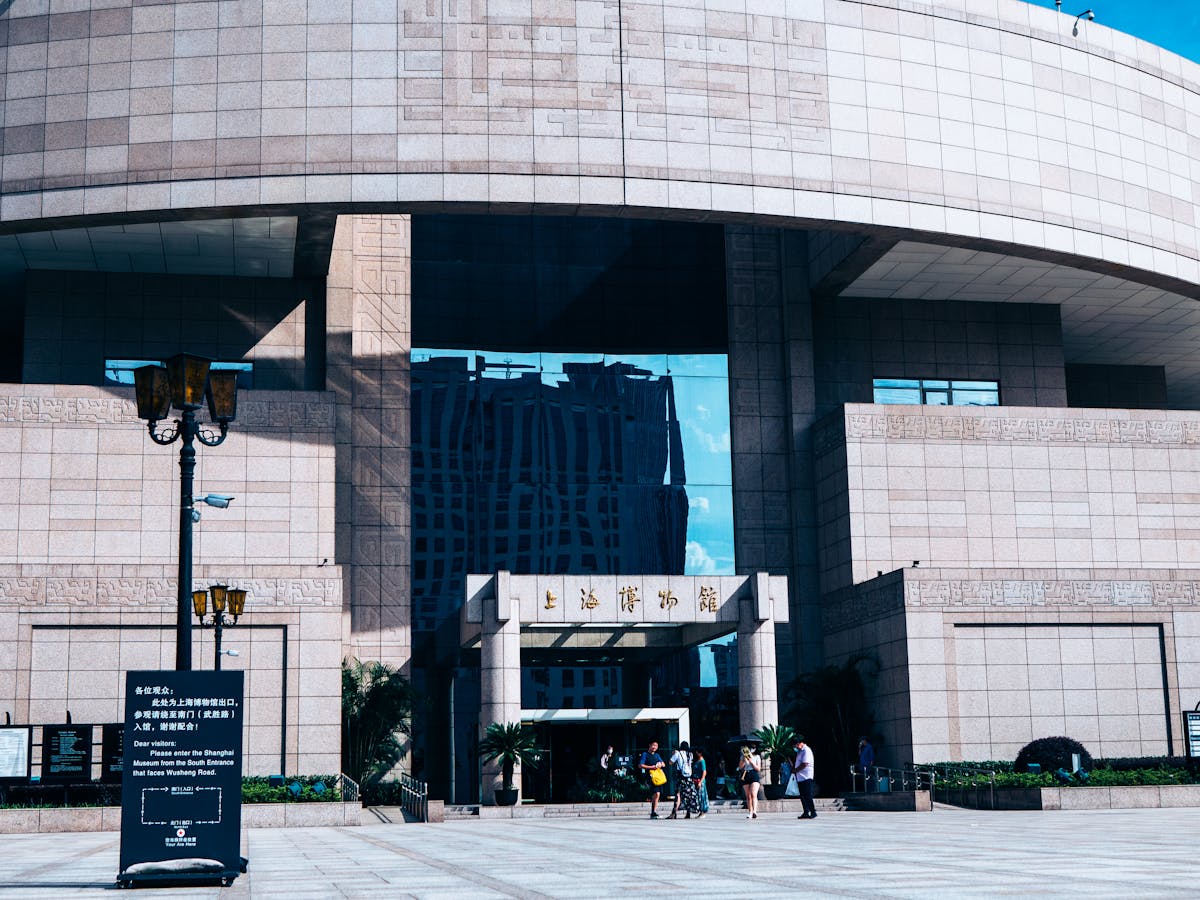
Set on the southern flank of People's Square, the museum occupies a 39,200-square-metre building that opened in 1996 and was designed by the Shanghai-based architect Xing Tonghe. Its silhouette is unmistakable from the square: a circular dome resting on a square base, a deliberate reference to a ding (鼎) — the three- or four-legged ritual cooking vessel that defines the museum's most celebrated gallery — and, in older Chinese cosmology, a shorthand for heaven (round) over earth (square).
Holdings approach 120,000 objects, of which roughly 8,000 are designated grade-one cultural relics by the Chinese state. Admission has been free since 2008. Online booking has been mandatory since 2020.
A ding-shaped building on People's Square
Xing Tonghe's design landed on the site in 1993 and the building opened on 12 October 1996, replacing earlier premises on Henan South Road that had served the collection since 1952. Five floors are visible above ground; a basement holds storage, conservation studios and a 300-seat auditorium. Granite and tinted glass clad the exterior; the inverted-arch dome is purely formal, not structural.
The collection in one paragraph
Roughly 120,000 catalogued objects span the chronological sweep of Chinese material culture, from neolithic painted pottery (c. 5000 BCE) through Shang and Western Zhou ritual bronzes (c. 1600–771 BCE), Han jades, Tang ceramics and figurines, Song landscape painting, Yuan blue-and-white porcelain, Ming and Qing furniture, and imperial seals and coins of every dynasty in between. Eleven permanent galleries handle this material thematically rather than chronologically — a choice that suits the depth of holdings in each medium and lets a serious visitor pick a specialism rather than march through 7,000 years in a single line.
How it's arranged, floor by floor
Each floor groups galleries by medium. A short summary:
- Floor 1 — Bronzes & Sculpture. The Bronze Gallery holds more than 8,000 pieces, widely judged the finest Shang–Zhou bronze collection in the world. Adjacent is the Sculpture Gallery, with stone Buddhist figures from Northern Wei (5th c.) through Tang (8th c.).
- Floor 2 — Ceramics. A chronological room running from neolithic Yangshao painted pottery to Qing famille rose. The Yuan blue-and-white section, in particular, is internationally significant; few museums outside the National Palace Museum in Taipei rival it.
- Floor 3 — Paintings, Calligraphy, Seals. Three galleries side by side. Painting holdings include works attributed to Tang, Song and Yuan masters. The Seals Gallery is small in physical scale but globally important — there is no comparable display of imperial and literati seal-stones outside Beijing.
- Floor 4 — Jades, Coins, Minority Arts, Furniture. A dense floor: Han and Ming jades; a long coin gallery covering 3,000 years of Chinese currency; a Minority Arts Gallery devoted to non-Han ethnic groups (clothing, silverwork, ritual objects); and a Ming–Qing Furniture Gallery reconstructing literati interiors.
Five pieces worth seeking out
Across 39,000 square metres of galleries, a few objects justify a visit on their own merit. Among them:
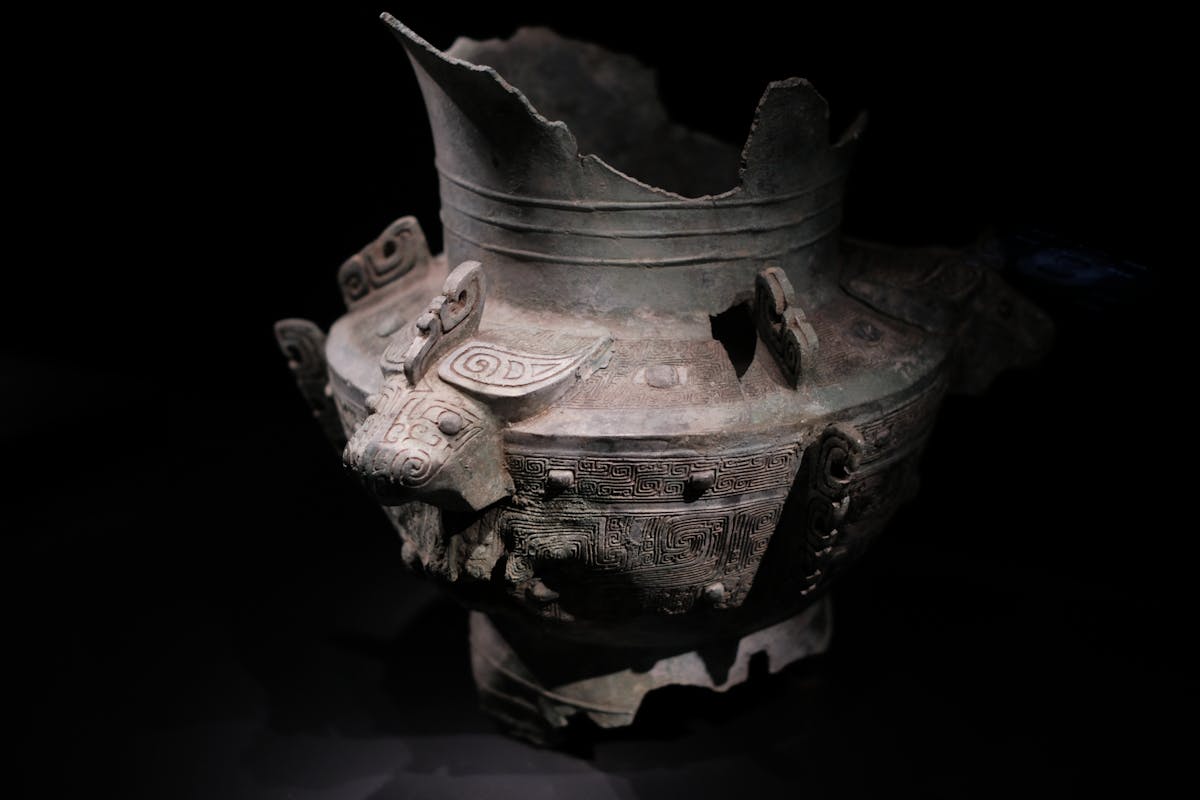
- Da Ke Ding (大克鼎). A Western Zhou bronze food vessel, cast c. 800 BCE, 201.5 kg and 93 cm high. Its interior bears a 290-character inscription recording an aristocratic land grant — one of the longest such inscriptions to survive. Acquired in 1959; first floor, Bronze Gallery.
- Lady at Music (唐人宫乐图). An anonymous Tang silk painting of court women playing instruments around a long table. Third floor, Painting Gallery; rotated for conservation reasons.
- Wang Xizhi calligraphy fragments. Jin dynasty (4th c.) brushwork attributed to the most celebrated calligrapher in Chinese history. Third floor, Calligraphy Gallery.
- Yuan blue-and-white plum vase. A 14th-century Jingdezhen piece — its form and cobalt-pigment quality defined what the West would later call "Chinese porcelain" for 600 years. Second floor, Ceramics Gallery.
- Qing imperial jade seal. A 19th-century seal in pale green nephrite, carved with a coiled-dragon handle. Fourth floor, Seals Gallery.
Booking, queues, timing
Online booking has been required since 2020; walk-up admission is no longer offered. Slots open seven days ahead via the English-language site (shanghaimuseum.net) and a WeChat mini-program; passport details are required for international visitors. Saturday-morning slots often vanish 48 hours ahead. Weekdays are easier.
At the door
Entry is by passport check at the south doors. Bag scanners and a metal detector are at the entrance — large backpacks must be left in the free cloakroom. Tripods, drinks and food are not permitted in the galleries. Photography without flash is allowed in the permanent collection; some special exhibitions disallow it entirely.
Audio guides in eight languages (English, French, German, Japanese, Korean, Spanish, Italian, Russian) rent for ¥40 from the desk right of the entrance, with passport or ¥400 cash deposit refunded on return. Special exhibitions cost ¥40–80 and must be booked alongside the free general-admission slot.
A half-day, a full day
Three to four hours covers a single-pass visit at moderate pace — enough to see one gallery seriously (typically Bronzes or Ceramics) and walk through the rest. Six hours allows two galleries in depth plus the others at a brisk pace. Anyone interested in a specific medium — Yuan blue-and-white, Tang painting, or imperial seals — should plan for a full day and consider returning.
Galleries close progressively from 16:30, and last entry to the building is firm at 16:00.
The east branch in Pudong
A second site, Shanghai Museum East, opened in stages from February 2024 on Yangsiyao Road in Pudong, just north of the Expo Park. It is much larger than the original (113,000 square metres of floor space against 39,200) and houses some of the modern, contemporary and rotating-exhibition programmes. Bookings and admission are managed separately.
Despite the new branch's scale, the People's Square building remains the historic centre of the institution and the location of most of the great pieces named above. A first visit should default to People's Square; the east branch suits second visits, special exhibitions, or visitors already in Pudong with a free afternoon.
The original branch holds the bronzes, the seals, the calligraphy and the Yuan ceramics. The east branch holds space, programming and breath.
Within People's Square, several other entries in this atlas sit within walking distance: the Bund is a 15-minute walk east, Yu Garden and the Old Town 25 minutes south-east, and Longhua Temple a 20-minute Metro ride south on Line 1. Cross-reference also with getting around Shanghai for fares and onward connections. Background reading is well covered by the Britannica entry on Chinese bronzes and its companion piece on Chinese ceramics.