Construction began in 1559 and finished eighteen years later, in 1577. Pan Yunduan, a mid-ranking official of the Ming dynasty's Sichuan administration, paid for the work as a gift to his father Pan En, then in retirement. The garden's name — Yu, meaning "pleasing" or "satisfying" — was chosen for the comfort it was meant to bring to an ageing parent. Pan En died in 1582, only five years after the garden's completion, and the family fortune declined within a generation. By the early Qing the garden had passed out of Pan hands, been partitioned, sold, neglected, occupied by rebel forces during the Small Sword Society uprising of 1853, and damaged repeatedly through the nineteenth and twentieth centuries.
What survives today is roughly two hectares — about five acres — of an originally larger compound. Six main scenic areas remain, restored systematically from 1956 onwards and reopened to the public in 1961. The result is the most coherent example of southern Chinese classical garden design within central Shanghai, and one of the few surviving features of the old walled city that predates the Treaty Port era by nearly three hundred years.
The garden's six zones
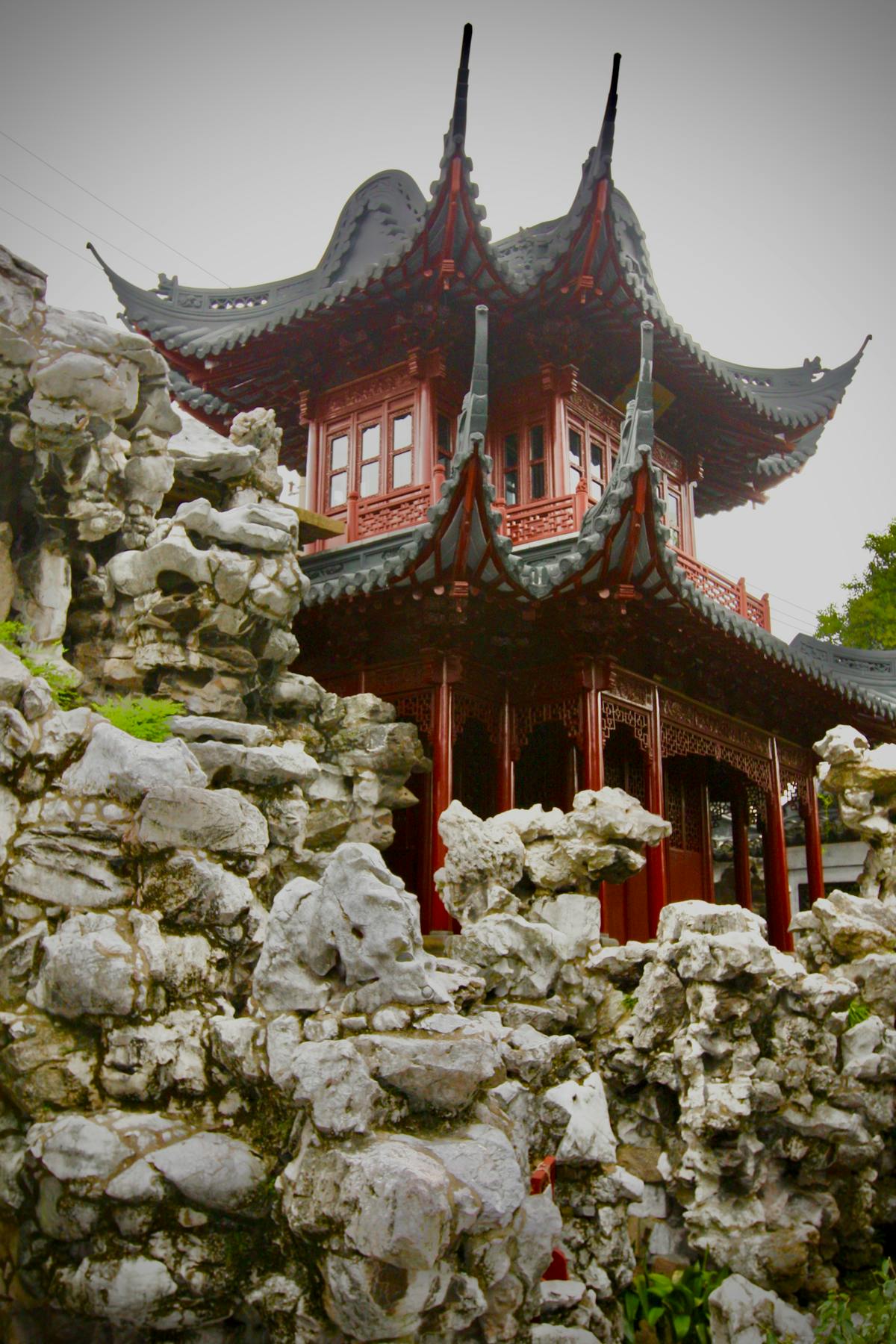
Visitors enter from the south and move broadly north and east through six named scenic areas, each separated by walls, water or rockery to create the layered sense of distance that southern garden design prizes. Sansui Hall (Three Ears Hall) sits near the entrance and was historically used to receive guests. Wanhua Chamber, further on, faces a small pond and was the residence wing. Dianchun Hall, at the centre, served as the headquarters of the Small Sword Society during their 1853–1855 occupation of the old city; a small exhibition inside still records that episode.
Huijing Hall and Yuhua Hall come next, the latter looking onto the Exquisite Jade Rock across a courtyard pool. The Inner Garden, in the southeast corner, was added in 1709, more than a century after the original construction, and forms a discrete walled garden-within-a-garden — a smaller compound with its own miniature pavilions, rockwork and stage.
Total walking time through all six zones, at an unhurried pace, runs ninety minutes to two hours.
The Exquisite Jade Rock
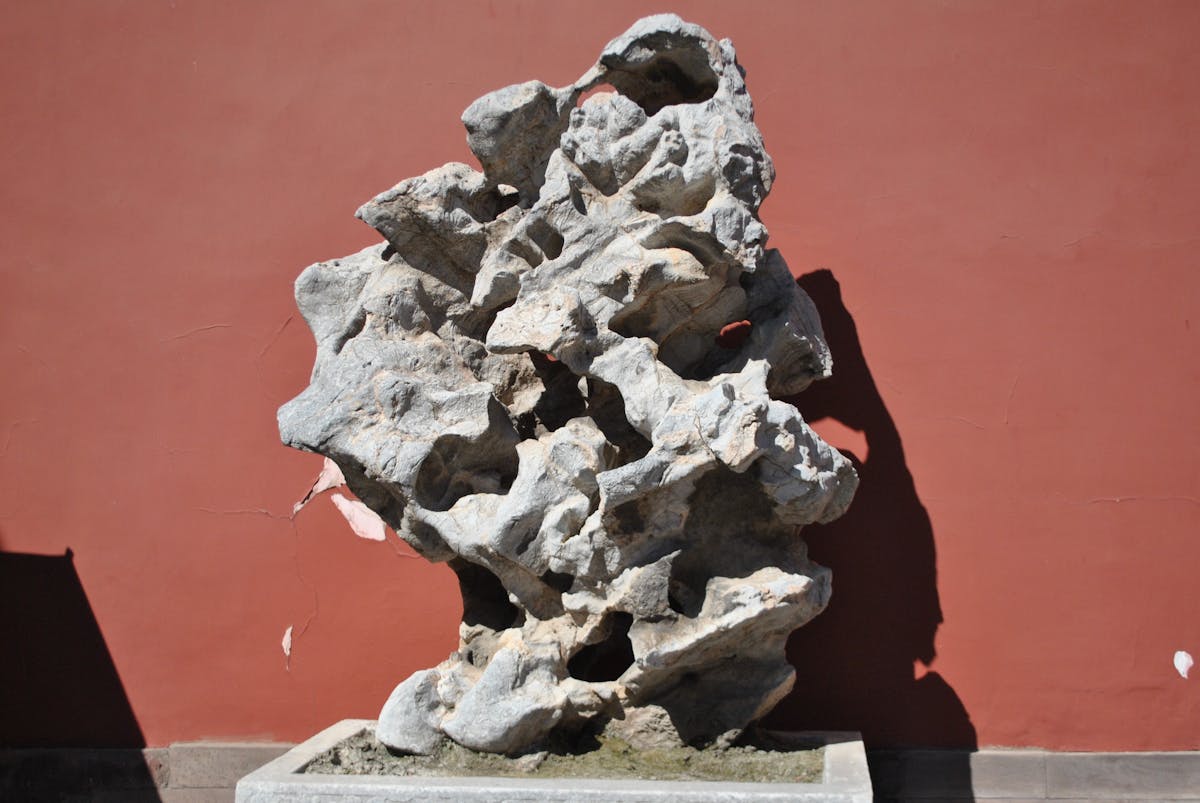
A four-metre limestone pinnacle called Yu Linglong, the Exquisite Jade Rock, is the single most-photographed feature of the garden. Pierced through with seventy-two natural holes worn by water over centuries, it stands in a small courtyard pool in front of Yuhua Hall, framed precisely so that water poured at the top runs out from every opening at once.
Its history is itself a story of Ming-era looting. Originally quarried from Lake Tai, the stone was being shipped, along with thousands of other prized rocks, to Bianjing (modern Kaifeng) for the Northern Song emperor Huizong's imperial garden Genyue, in the early twelfth century. The barge carrying it sank in the Huangpu, and the rock lay in the river mud for some four hundred years before being recovered and installed at Yu Garden during construction. Two other rocks of comparable Lake Tai stock are still claimed as imperial salvage in Suzhou and Hangzhou, but the Yu Garden specimen is the largest and most clearly documented.
Lake Tai stones
Lake Tai limestones (taihushi) are prized in Chinese garden design for the qualities of "thinness, openness, perforation and wrinkle" set out by the Northern Song aesthetic theorist Mi Fu. The Exquisite Jade Rock is the textbook example, and is regularly cited in Britannica's account of Chinese garden tradition as the finest surviving example outside imperial collections.
The Dragon Wall and its four-clawed beasts
Five undulating walls, each about thirty metres long, separate the garden's main zones. Each is topped by a sinuous tile sculpture in the form of a dragon's body, head raised at one end and tail at the other. They are universally referred to as the Dragon Walls, and most signage and guide material calls them dragons.
Strictly speaking, they are not. Imperial law during the Ming and Qing reserved the five-clawed dragon for the emperor's exclusive use; depicting one on a private residence was a capital offence. Pan Yunduan's solution, repeated by every Ming-era private garden, was to give the creatures four claws and a slightly altered snout, allowing them to be officially classified as a different mythical beast — a jiao or a chi — while looking essentially identical to a dragon. Visitors today are told to count the claws.
Four claws to keep the magistrate happy; everyone knows what they really are.
Closest to Wanhua Chamber, one Dragon Wall is the most photographed of the five, partly because morning light hits the head end at a usable angle around 10:30.
Yuyuan Tourist Mart and the Huxinting teahouse
While the garden has a separate ticketed entrance, the streets immediately outside it form the Yuyuan Tourist Mart — several blocks of low Ming-revival architecture (most of it twentieth-century, rebuilt in period style) selling souvenirs, dumplings, tea and dried goods. Architecture in the lanes is theatrical rather than authentic, and the crowds blur the distinction between commercial-tourist activity and the garden itself. Plan to walk through the Mart, not linger in it.
One feature of the surrounding precinct is genuinely old. Huxinting (Mid-Lake Pavilion) was built in 1784 on a small artificial island in the zigzag pond at the centre of the bazaar, reached by the Bridge of Nine Turnings. It has operated continuously as a teahouse since 1855 and is among the oldest still-functioning teahouses in Shanghai. A pot of green tea on the upper floor costs ¥80 to ¥150 and includes refills and small dishes of dried fruit and nuts. Queen Elizabeth II took tea there in 1986; a small framed photograph commemorates the visit.
Why does the bridge zigzag nine times? Evil spirits, in Chinese folk belief, can only travel in straight lines.
When to come
Yu Garden is one of Shanghai's most-visited attractions, and during peak season (Chinese national holidays, summer school holidays, weekends from April to October) the inner courtyards become congested enough to make the layered sight-lines that define the garden invisible behind groups of forty.
Three timing rules help. Arrive at opening — 09:00 — and aim to be inside the gates within the first ten minutes; tour groups typically reach the garden between 10:30 and 11:00. Avoid Saturdays and Sundays where possible; weekday mornings are markedly quieter. And avoid Chinese national holidays altogether, particularly the first week of October (National Day) and Chinese New Year, when single-day visitor numbers can exceed forty thousand against a normal weekday volume of four to six thousand.
For a different experience, the garden hosts the Yu Garden Lantern Festival annually from mid-September to mid-October around the Mid-Autumn Festival. Hundreds of silk lanterns are hung through the courtyards and along the Tourist Mart streets, and the garden stays open into the evening. Lantern-festival admission is priced separately at ¥80–120, and the event is worth seeing once for its scale, though the daytime architecture is largely obscured.
Tickets and access
Standard admission is ¥30, rising to ¥40 during peak season (broadly April–June and September–November). Tickets are sold at the south entrance kiosk and via the official WeChat mini-programme; online tickets carry a small discount and skip the on-site queue. Entry is free for children under 1.3 metres, visitors over 70 years of age (with passport identification), and visitors with documented disability.
Opening hours are 09:00 to 17:00, with last admission at 16:30. Closures fall every Monday for maintenance, except during major public holidays. Photography is permitted throughout; tripods and professional equipment require advance permission from the garden administration office. Drone photography is prohibited under Shanghai-wide airspace rules.
Access is straightforward by metro: Line 10 or Line 14 to Yuyuan Garden station, then a five-minute walk through the Tourist Mart lanes. By taxi, ask for Yu Yuan (豫园) — drivers will set down at the southern edge of the pedestrianised zone, from where the entrance is signed. Information for international visitors is also maintained by the Shanghai municipal government's tourism portal, including a current-year holiday calendar.
| Item | Standard | Peak season |
|---|---|---|
| Adult admission | ¥30 | ¥40 |
| Lantern festival evening | — | ¥80–120 |
| Children under 1.3 m | Free | Free |
| Visitors over 70 | Free (with ID) | Free (with ID) |