At 210 Taikang Road, Xuhui District, a single ungated entrance leads into seven narrow lanes occupying roughly three city blocks south of the main Concession spine. Together they form Tianzifang (田子坊) — a knot of restored shikumen courtyard houses packed with around 200 small shops, ceramics studios, embroidery stalls, galleries and cafés. The lanes are paved, vehicle-free, never wider than three metres, and on weekends so thoroughly congested that progress is measured in shoulder-turns.
Shikumen residential lanes
Shikumen — literally "stone gate" — is a hybrid lane-house typology that emerged in Shanghai in the 1860s and peaked between 1910 and 1930, marrying a Jiangnan courtyard plan with British terrace-house construction. By 1949 roughly three-quarters of the city's housing was shikumen.
The Tianzifang block was built in the 1920s as worker and lower-middle-class housing on the southern edge of the French Concession. Encyclopedia Britannica describes the form as central to Shanghai's pre-war urban character, though roughly 70% of pre-war lane housing has been demolished for high-rise redevelopment. Tianzifang is one of the survivors.
One detail distinguishes it from the better-known Xintiandi block to the north: Tianzifang was never fully cleared of residents. Many original tenants still occupy upper floors of buildings whose ground floors are now shops. Laundry hangs from second-floor windows above ceramic studios; an elderly resident may be cooking dinner two metres above a tea showroom. This co-existence is the area's defining quality.
How it became an art district
Conversion began informally around 1998, when the painter Chen Yifei (1946–2005) opened a studio in lane 210 — a former candy-factory building on the lane's main spine. Designers and photographers followed within two years, drawn by low rents and architectural texture. By 2003 the area had a name (Tianzifang, from a classical reference) and the Lukouqiao block had become a recognised informal arts cluster.
Crucially, this was tenant-led rather than top-down. The municipal government did not clear residents; it negotiated piecemeal, and the resulting fabric is a patchwork — some buildings entirely commercial, others residential above commercial. Shanghai's municipal tourism office describes Tianzifang as one of two surviving shikumen examples accessible to visitors, markedly different in character from Xintiandi. By 2010 it held roughly 200 commercial tenants, with high turnover: a silk-scarf stall in 2015 may by 2026 be a coffee bar or tattoo parlour.
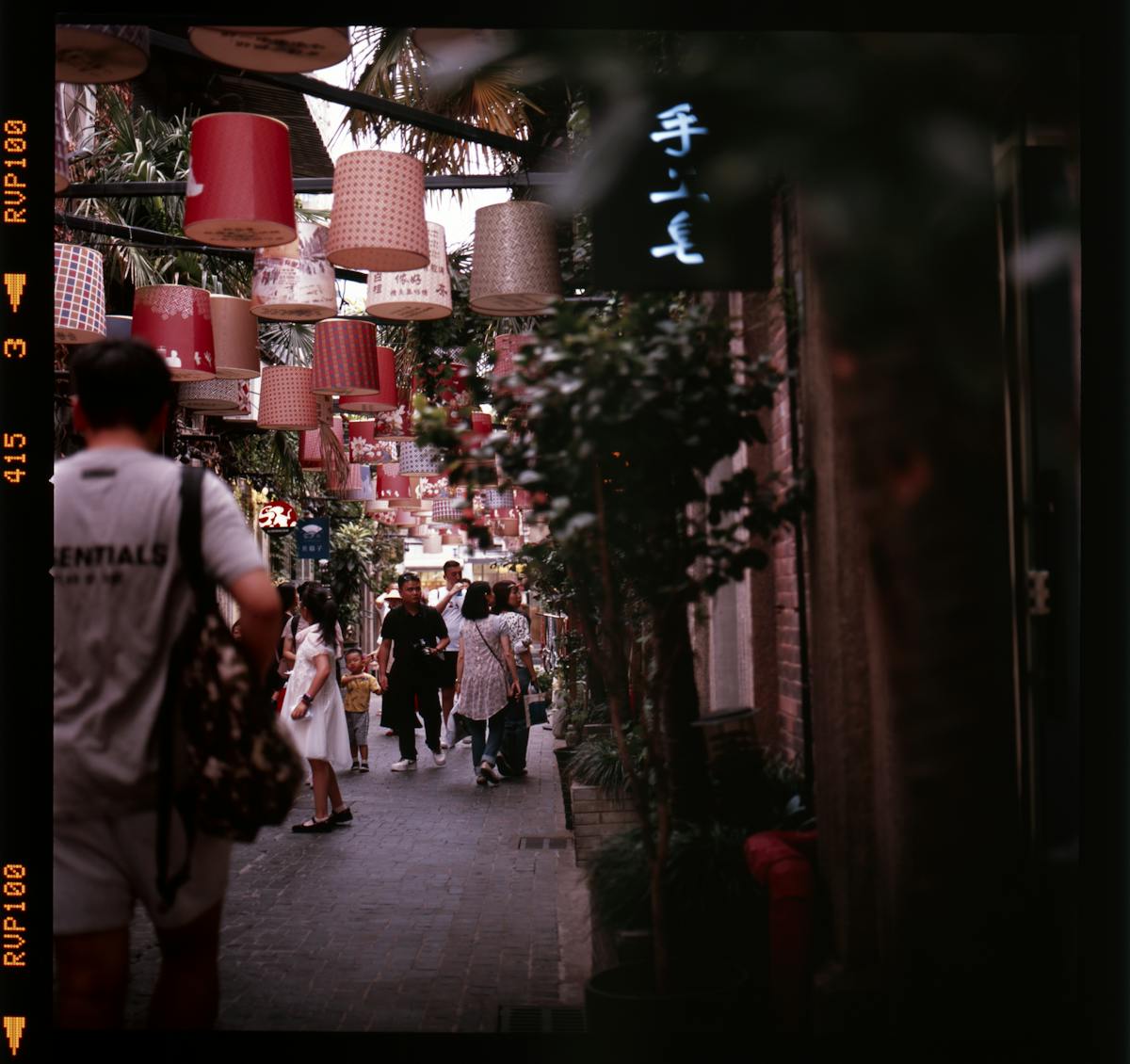
Shops, cafés, galleries
Tenants fall into roughly five categories. Ceramics studios — Jingdezhen porcelain, contemporary Shanghai studios, Korean and Japanese imports — occupy a disproportionate share of ground-floor retail. Traditional Suzhou embroidery, hand-stitched on silk panels, has several specialist outlets concentrated on lane 248. Tea retailers selling Yunnan pu'er and Fujian oolongs operate five or six storefronts, most with tasting tables. Small contemporary galleries — one-room shows rotating monthly — cluster on the eastern edge around lane 274. Independent design (leather, jewellery, paper, framed photography) fills most remaining space.
Pricing varies: a handmade ceramic teacup ¥80–250, an embroidered silk panel ¥600–3000, a contemporary print ¥400–1200. Bargaining is acceptable in smaller stalls, uncommon in established studios.
Photography note
Commercial photography is not permitted in the residential portions of the lanes — these are upper floors and inner courtyards still occupied by long-term residents. Casual visitor photography of shopfronts is fine; setting up tripods, lighting, or models against residential buildings is not, and is enforced by lane-block stewards in red armbands during weekend hours.
Compared with Xintiandi
Roughly one kilometre north sits Xintiandi, a better-known shikumen redevelopment opened in 2002 by Hong Kong developer Shui On — a top-down rebuild that relocated residents, gutted two blocks, and let the fabric to luxury brands, chain restaurants and a five-star hotel. Visual language is polished; prices reflect it.
Tianzifang is the opposite case study. Lanes are uneven, surfaces patched, electrical conduits stapled to brick. Tenants are independent rather than chains; rents, though rising, remain accessible to small operators. Residents still live overhead. Where Xintiandi feels staged, Tianzifang feels improvised.
Many visit both in a single afternoon: Metro Line 10 connects Xintiandi station to Dapuqiao (Line 9) in fifteen minutes via South Shaanxi Road.
Eating and drinking
Cafés are the most numerous food businesses, with around thirty across the seven lanes. Several occupy second-floor or rooftop spaces, accessed by narrow internal staircases that — when ground-floor lanes are gridlocked at 14:00 on a Saturday — provide the only useful elevation for a view across the tile roofs. Coffee runs ¥30–55 per cup. Most shops accept Alipay and WeChat Pay; a few older operators still take cash only.
Restaurants are fewer but cover wider ground. Three or four sit-down establishments serve Shanghainese cuisine — xiaolongbao (¥45–80 a basket), drunken chicken, red-braised pork belly. Sichuan options exist on lane 248. Non-Chinese tenants include a handful of Japanese izakaya, two Italian operations, and a long-running Iranian café near the Taikang Road entrance. Rooftop seating commands a 15–25% premium.
Of all the surviving shikumen districts, Tianzifang is the only one where dinner can still be cooked above your café table.
Timing and crowds
Crowd density is the single most variable factor in a visit. Weekday late mornings (10:00–12:00) are comfortable, with most shops open by 10:30 and lane traffic still light. Weekday late afternoons (16:00–18:00) are a second viable window. Weekends from 13:00 to 19:00 are at or beyond comfortable capacity; movement through the central lanes can slow to under one metre per second.
Shops keep their own hours — typically 10:30 to 22:00, with cafés often opening earlier (08:30) and galleries closing earlier (19:00). National holidays, particularly October Golden Week and Chinese New Year, see dramatic crowd peaks.
Access is via Dapuqiao station on Metro Line 9, exit 1, then a five-minute walk south on Sinan Road and east on Taikang Road. The main entrance at 210 Taikang Road is signed in English and Chinese; secondary entrances exist on Jianguo Middle Road and Ruijin Second Road.