50 Moganshan Road sits on the south bank of Suzhou Creek, half a kilometre west of where the canal bends past the old godowns of Zhabei. Behind a low brick wall and an unpainted gate, twenty-odd factory buildings of the former Shanghai Chunming Roving Mill — built in 1937, decommissioned in the late 1990s — now house roughly one hundred galleries, studios and design firms. The address abbreviates to M50, and the abbreviation has become the name.
Tenants began moving in around 2000, when artists priced out of the more central French Concession found that mill-owners on the creek were renting raw factory floors at near-derelict rates. A formal repositioning of the compound followed between 2002 and 2005. Two decades on, M50 is privately occupied, commercially focused, and the closest thing Shanghai has to a single-address survey of its contemporary art scene.
From textile mill to art district
Shanghai Chunming Roving Mill was built in 1937 as part of a broader cluster of textile-making works strung along Suzhou Creek, then the industrial spine of the city. Cotton roving — the loose, twisted strand spun before final yarn — was prepared here, and the spatial logic of the buildings reflects that production: long single-storey sheds for spinning machinery, brick weaving halls with sawtooth roofs to catch north light, narrower utility blocks for boilers and water reservoirs. Construction continued in fits through the 1940s and 1950s, with later additions in the 1970s and 1980s in plainer concrete.
Operations wound down through the 1990s as Shanghai's textile industry shifted west and offshore. By 1999 most of the floor space was empty.
Around that time, painters working out of small studios in central Shanghai began renting unused factory floors at Moganshan Road for a fraction of inner-city rates. Xue Song, Ding Yi and a handful of others were among the early tenants. Word travelled quickly within the small Shanghai art community of the time, and within three years the compound had filled. A formal repositioning followed between roughly 2002 and 2005, with the buildings rebranded as a creative-industries park under the umbrella name M50, after the street number.
What was not rebuilt is much of what gives the place its texture today: brick exteriors stayed brick, steel trusses stayed exposed, factory windows kept their thin steel mullions, and the loading bays of the original sheds still open onto the central yard. New tenants painted over interiors and installed gallery lighting, but the shells were largely left alone.
Roughly a hundred spaces
Current occupancy at M50 sits at around one hundred tenants, though the precise number fluctuates as galleries open, close and consolidate. Of those, roughly forty are commercial galleries representing contemporary Chinese and international artists; another thirty-odd are working studios for individual painters, sculptors or photographers; the remainder are graphic-design firms, architecture practices, small workshops and a handful of cafés.
Buildings are numbered rather than named. Building 6 holds several of the larger galleries on its ground and first floors. Buildings 17 and 18 are clusters of smaller studios accessed through narrow internal staircases. Building 4 hosts photography-focused tenants. A printed map is available from the small visitor desk near the main gate, and most galleries also post the building number on their website listings.
Practical note
Some studios are open to the public during gallery hours; others are by appointment only. Closed doors with a name plate usually mean the latter — a polite knock during weekday afternoons sometimes works, but visitors arriving for a specific artist's studio should email ahead.
Notable galleries
For visitors with limited time, four spaces tend to be the standard starting points.
ShanghART (Building 16, ground floor) was founded in 1996 by the Swiss gallerist Lorenz Helbling and is one of the earliest contemporary art galleries to operate in mainland China. The roster has long centred on a tight group of Shanghai-based painters and conceptual artists — Zhang Enli, Yu Youhan, Ding Yi, Sun Xun, Xu Zhen, Liang Shaoji — many of whom are now exhibited internationally. ShanghART occupies a substantial first floor at M50 and rotates a serious exhibition programme of six to eight shows per year.
Eastlink Gallery (Building 6, fifth floor) opened in 1999 and concentrates on Chinese conceptual and installation art. Programming is more experimental than ShanghART's; shows have included multimedia installations and performance documentation that wouldn't fit easily in a more commercial space.
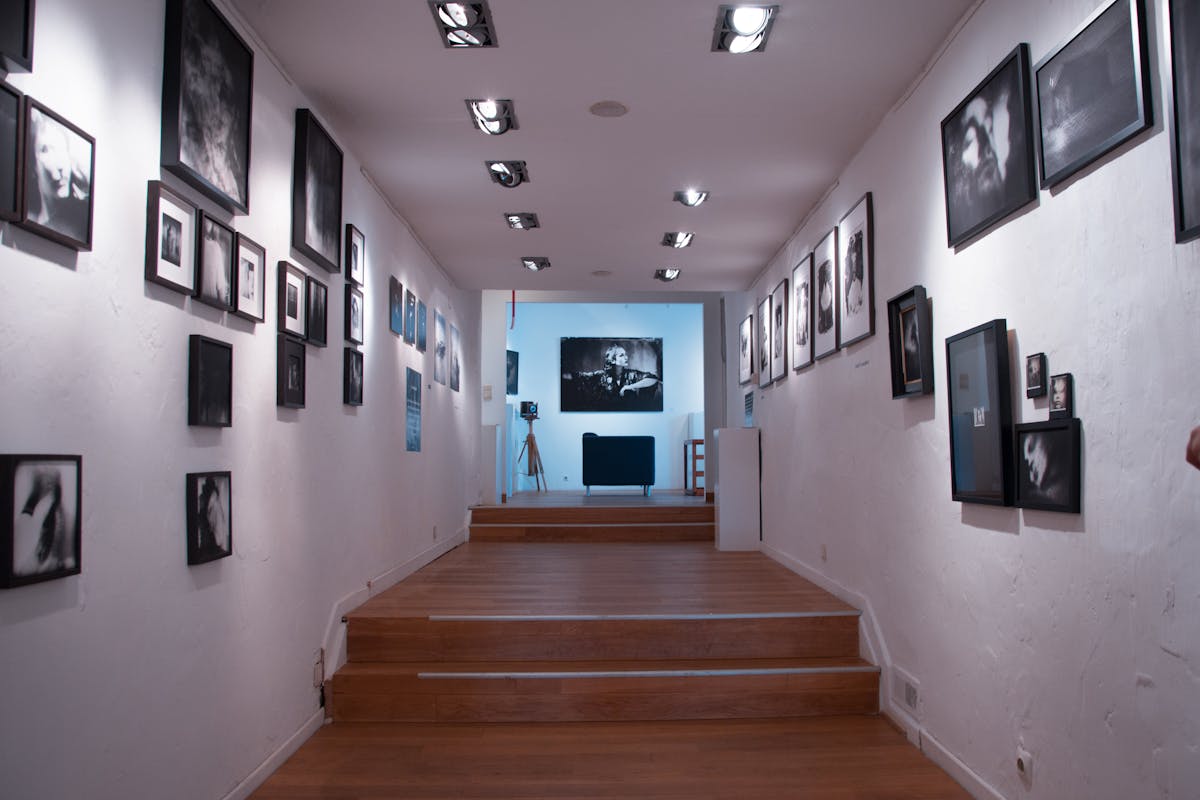
OFOTO Gallery (Building 13) is a photography-only space showing both Chinese and international photographers, with regular shows of younger Shanghai-based artists. m97, founded in 2007, also focuses on photography and represents a mix of Chinese photographers and twentieth-century international names — the only gallery in the compound that consistently shows large-format vintage prints.
Beyond these four, a wander through any two or three buildings will turn up smaller spaces worth ten minutes. Quality varies — some studios are genuinely producing serious work, others are commercial-decorative — but the density rewards casual browsing.
Within Shanghai's art ecology
Three places define contemporary art viewing in Shanghai, and they sit in clear contrast with one another.
Power Station of Art (PSA), the city's main state-funded contemporary art museum, occupies a converted 1985 thermal power plant on the south bank of the Huangpu, a former pavilion of the 2010 Expo. PSA is institutional, free to enter, and hosts the Shanghai Biennale every two years; its programming is curatorial and collection-led rather than commercial.
The West Bund Cultural Corridor, a linear strip of museums and galleries developed since around 2014 on the Xuhui riverfront, is newer, more polished and more institutional in feel. The Long Museum (West Bund), Yuz Museum and the West Bund Art Centre are the anchor spaces, and the annual West Bund Art & Design fair held there each November is now the most important commercial art fair in mainland China.
M50, by comparison, is older, scrappier and almost entirely commercial. There is no curatorial overlay, no entrance fee, no integrated programming across galleries. What it offers is breadth in a single visit — a hundred independent operators within a ten-minute walk — and a continuity of place that goes back to the late 1990s, when contemporary art in Shanghai was still an essentially marginal activity.
The mill stayed. The textiles left, the painters arrived, and the brick walls absorbed both shifts without comment.
Visitors interested in seeing all three would typically allow a half-day each: PSA on a free morning, West Bund as a longer afternoon with one or two museum entries, M50 as a self-paced two to three hours of gallery hopping. See also the entries on the Bund opposite Pudong, and the Shanghai Museum at People's Square for the historical-art counterpart to M50's contemporary focus.
Access, hours, photography
Metro Line 13 to Jiangning Road station, exit 1, is the closest stop — a six-minute walk north to the gate. Line 1 to Shanghai Railway Station also works; the walk from the southern exit of the railway station, west along Hengfeng Road and across Suzhou Creek, is about fifteen minutes. Taxis from People's Square run ¥18–25 and take ten to fifteen minutes outside rush hour.
Entrance to the compound is free and there is no ticketing of any kind. Individual gallery exhibitions are typically free; a few special shows charge ¥20–50, payable at the gallery's own front desk.
Most galleries open at 10:00 and close at 18:00, and most are closed on Mondays — though hours are set independently and a handful keep eccentric schedules. The compound's central yard and the corridors of the buildings remain accessible during posted hours regardless. Saturday and Sunday afternoons are the busiest.
Photography inside galleries is permitted unless an individual exhibition specifies otherwise — a small no-camera icon at the entrance to a particular show is the usual signal. Tripods generally require permission; phone and handheld cameras are fine.
When to visit
Two windows are worth knowing about. Early November coincides with the West Bund and ART021 fairs across the river, and most M50 galleries time their strongest shows of the year to that fortnight; openings cluster across consecutive Saturdays and the compound becomes effectively a parallel fair. Late spring (April–May) is the second peak, when rotating shows clear out the winter programme and several galleries open commissioned new work.
August is the slowest month: humidity reaches its annual peak, several galleries close for two-week summer breaks, and exhibition turnover stops. February around the Spring Festival is similarly quiet.
Allowing two to three hours is realistic for a first visit covering five or six galleries plus a casual circuit of the yard. A more thorough visit covering ten to twelve spaces takes most of an afternoon. Cafés inside the compound are adequate but unremarkable; better food is a fifteen-minute walk south in the Jing'an grid around Yuyuan Road. For onward navigation, see getting around Shanghai; for a different kind of converted compound — older lane housing turned into shops and cafés — see Tianzifang.