Sun Quan, ruler of the Wu state during the Three Kingdoms period and a figure familiar from the Romance of the Three Kingdoms, is credited with founding Longhua Temple in 242 AD — three and a half centuries before Shanghai was incorporated as a market town. What remains today: a working monastery of around fifty Mahayana Buddhist monks, five axial halls last rebuilt in 1875, and one brick-and-wood pagoda from 977 — the oldest standing structure inside present-day Shanghai.
Admission is ¥10, among the cheapest temple tickets in the city — Longhua functions less as a tourist attraction than as a religious site open to visitors.
1,700 years of rebuilding
Almost nothing of the 242 AD foundation survives. Wooden monastic complexes in eastern China rarely outlast two or three centuries before fire, neglect or political upheaval erases them. Longhua was destroyed and rebuilt repeatedly through the Tang, Song, Yuan and Ming periods. A reconstruction in 977 under the Northern Song produced the pagoda that still stands; the surrounding halls date mostly from a Qing-dynasty rebuild in 1875, with restoration in the 1980s and early 2000s.
What persists is the layout — the axial sequence of halls, the orientation, the ground itself. A traveller in 977, or 1300, or 1700 would have walked roughly the same route through roughly the same courtyards.
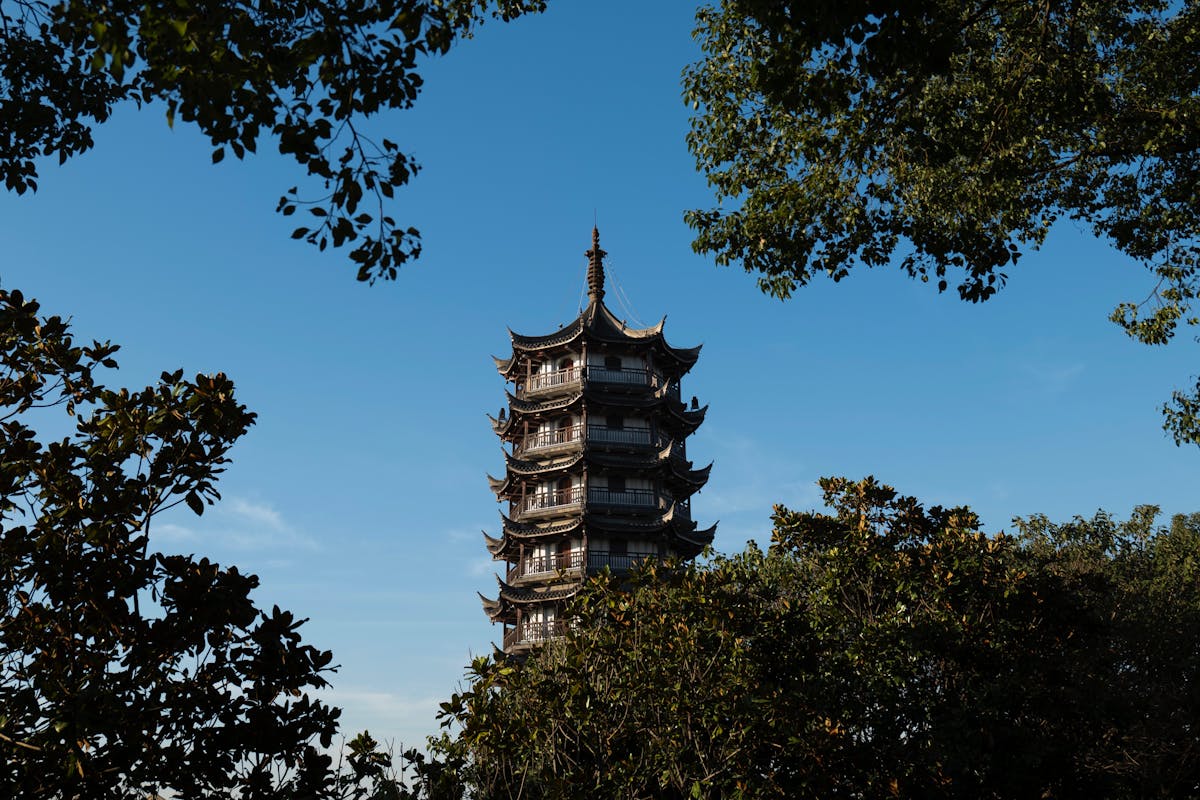
The Song-era pagoda
Strictly speaking, the pagoda sits outside the temple wall — across a small lane on the western side. It dates to year two of the Taipingxingguo era of the Northern Song, which converts to 977 AD. At 40.6 metres tall, octagonal, seven storeys high, it is built of brick around a wooden frame, with timber eaves projecting at each tier and a small bell at every corner — fifty-six bells in total when intact. In windy conditions the bells can be heard from the courtyard opposite.
Visitors cannot enter. Climbing access was closed after structural surveys in the late 1970s. From outside, the proportions are clean — taller than wide, slightly tapered, each tier a fraction shorter than the one below.
The oldest standing building in modern Shanghai is not in Shanghai proper. It is in Xuhui, on a quiet lane, ¥10 to walk past.
The five halls
Inside the wall the layout follows the standard Chinese Buddhist axial plan: five main halls aligned north-to-south, each elevated slightly above the last, connected by courtyards. Visitors enter from the west gate (the north gate is often closed).
- Maitreya Hall — first along the axis, with the seated, laughing Maitreya Buddha.
- Heavenly Kings Hall — four guardian deities, one in each corner.
- Mahavira Hall — principal hall, central Sakyamuni Buddha flanked by past and future Buddhas. Largest of the five.
- Three Saints Hall — Amitabha and the bodhisattvas of the Western Pure Land tradition.
- Abbot's Quarters — northernmost, partially closed to visitors.
Photography is permitted in courtyards but not inside the halls. Monks chanting morning and evening services occupy the main halls around 06:30 and 16:00; visitors stay out during those windows.
The bell and the New Year ceremony
A 16-tonne bronze bell, cast in 1382 during the early Ming dynasty, hangs in a separate tower on the eastern side of the temple. It is one of the largest surviving Ming-era bells in eastern China, rung once a year for the New Year's Eve ritual: 108 strikes at midnight, drawn from the Buddhist conception of the 108 worldly desires that obstruct enlightenment. Each strike removes one.
Attendance is among the largest annual gatherings in Shanghai. Tickets to enter the grounds at midnight on 31 December are released through the temple's website roughly six weeks in advance and routinely sell out within hours; for those without tickets, the bell is audible from streets several blocks away.
Practical note
For visitors not present in late December, the bell is rung in summary form on the first day of every lunar month — three strikes, around 06:00. A much smaller event at far less crowded scale.
Plum blossom in spring
Longhua sits inside what was historically a plum garden. Plum blossom (mei hua) typically opens between mid-March and early April depending on the year's weather, and the grounds plus the small park immediately south have been one of the city's traditional plum-viewing spots for several centuries — pink and white flowers, slight fragrance, viewable for free from the surrounding park.
An annual plum blossom festival runs during the bloom window, with extended evening hours on selected dates; listings appear on Visit Shanghai in late February each year. Weekday mornings are calmer than peak weekends.
Memorial garden, 1934–1948
One section of the compound carries weight beyond its Buddhist function. From 1927 to 1937 the surrounding district housed the Songhu Garrison Command, used by the Nationalist government as a detention and execution site for political prisoners — predominantly leftist activists and Communist Party members. From 1937 to 1945, after Japanese forces occupied Shanghai, parts of the temple compound itself were repurposed as a prison.
A small memorial garden on the eastern edge marks those executed at the site between 1934 and 1948; stone tablets list the recovered names. Background context appears on Britannica's overview of Chinese Buddhism and in material maintained by the Shanghai municipal government. Entrance is included in the ticket; the garden is quiet and easily missed.
Tickets, vegetarian meals, access
Standard admission is ¥10, payable by Alipay, WeChat Pay, or cash at the west gate ticket window. Hours run 07:00 to 16:30 daily, last entry 16:00. Longhua closes earlier than most central-Shanghai sights — arriving after 15:00 leaves only a short window.
Free vegetarian Buddhist meals are served at midday on the second floor of the dining hall, a short walk from the Mahavira Hall. Service runs 11:30 to 12:30. Food is simple — rice, several vegetable dishes, a soup — and donations of ¥10 to ¥20 are typical though not required. Seating is communal and silent during service; visitors clear their own bowls.
Access is via Metro Line 11 or Line 12 to Longhua station; from exit 2, a five-minute walk south leads to the west gate. Taxi from the Bund area costs roughly ¥45–60, around 25 minutes. For broader context, see getting around Shanghai. For comparison against the city's other major Buddhist temple, Jing'an Temple in central Puxi offers a sharper contrast — gilded modern restoration, ¥50 ticket. Longhua is older, quieter, less polished.