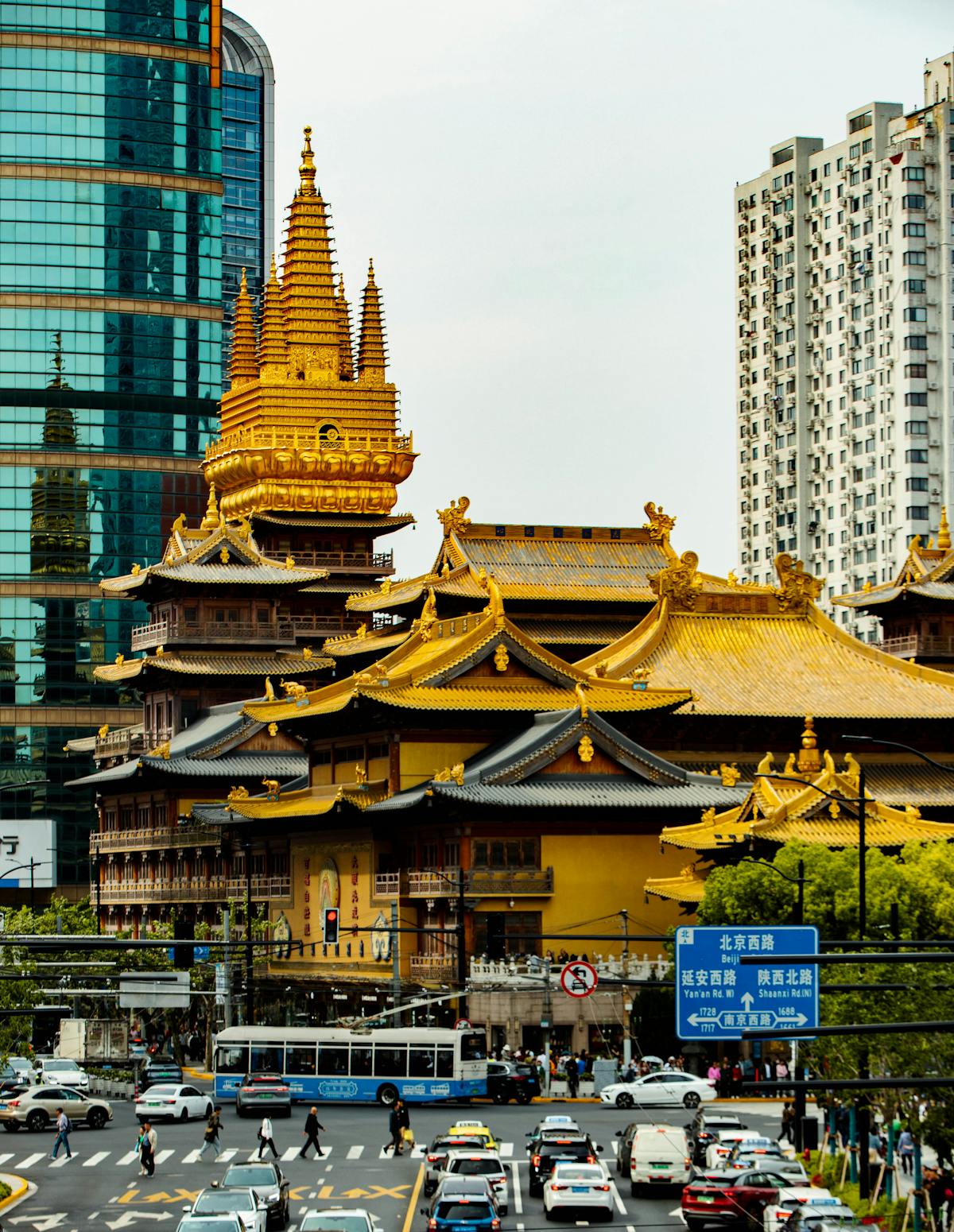
Step out of Jing'an Temple metro station at exit 1 and the contrast is immediate: a 50-metre-tall gilded roof on one side of the road, Plaza 66's glass façade on the other, LED billboards reflecting off both. Eighteen centuries of religious continuity, set inside a luxury shopping district. Its address — 1686 Nanjing West Road — is shared, in spirit, with Cartier and Louis Vuitton.
Most of what stands is recent. Walls and roof rebuilt in 2010, the largest bronzes installed in 2014, entry charges raised from ¥30 to ¥50 in 2018. Yet the 247 AD foundation date is older than nearly any continuously-named institution in the city, and the layout still follows Chinese Mahayana convention: three halls on a single south-facing axis.
Eighteen centuries of rebuilding
Jing'an's foundation is recorded in 247 AD, during the Three Kingdoms period under Wu, originally as Hudu Chongxuan Temple. Its first site was not the present one — original buildings stood by the Wusong River, several kilometres north. A move to the current location came in 1216 (Southern Song), when shifting riverbanks made the old site unworkable.
Major rebuilds followed in the Tang, Song and Ming dynasties; an 1880 late-Qing reconstruction produced the form most twentieth-century photographs record. After the Cultural Revolution — when the temple was closed and partly converted to a plastics factory — a 1953 restoration reopened it by the early 1980s. A far larger 2010 reconstruction then replaced most of the post-1953 fabric with a gold-leaf roof, taller halls and heavier bronzes.
What survives in original form is small. A bronze bell of disputed Tang origin hangs in the bell tower; stone fragments sit in side chambers. Most else is recent.
Continuity vs. fabric
What "founded 247 AD" means here: institution is continuous, site is 800 years old, almost none of the physical building predates the twentieth century. Mahayana Buddhism in China has long treated rebuilding as part of a temple's life rather than a rupture in it.
What was built in 2010
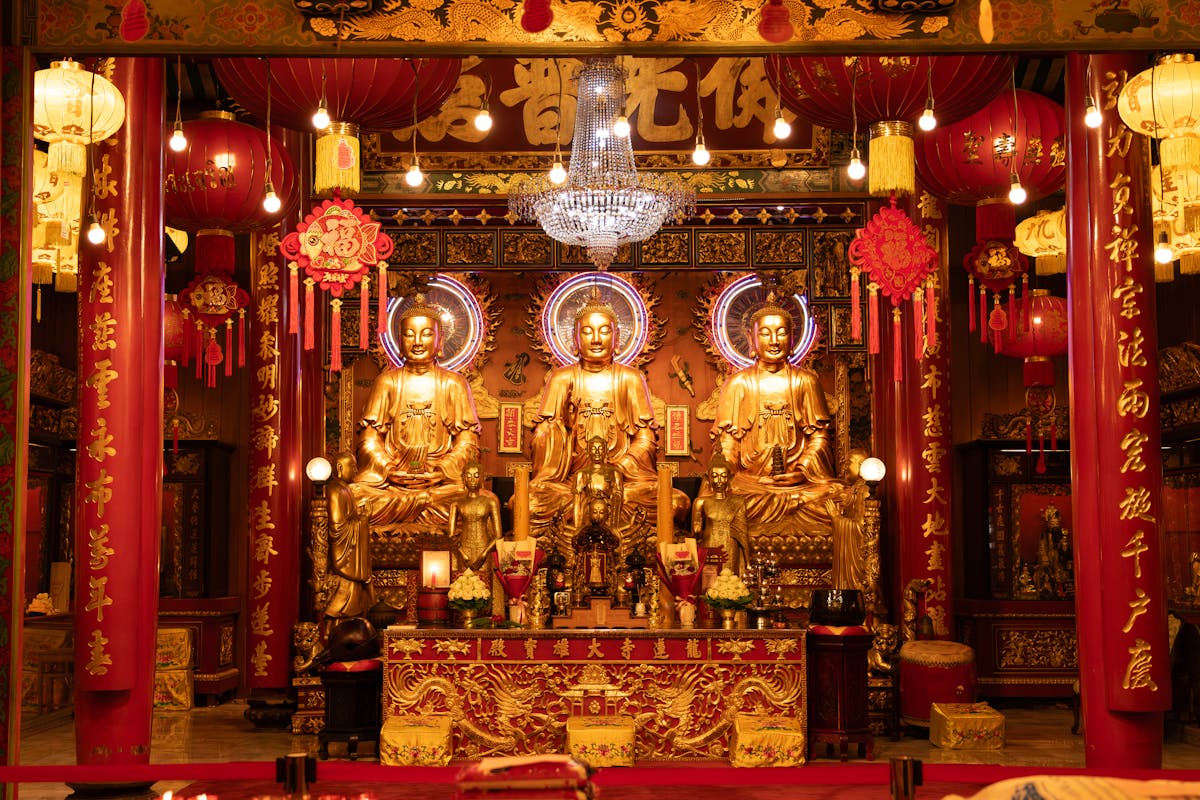
What most visitors see is the 2010 reconstruction. Traditional Chinese timber-frame, stepped roofs in green-glazed tile beneath the famous gold leaf, a perimeter of red lacquered columns. Footprint matches the late-Qing temple; heights are taller. From Nanjing West Road, the silhouette is the gilded Mahavira Hall and twin pagoda-style towers flanking the south entrance.
Some iconography departs from strict Han Chinese Buddhist convention. Several upper-floor altars display Vajrayana (Tibetan) elements alongside the Mahayana mainstream — reflecting the abbot's reformulation of the temple's programme during the 2000s.
Inside the three halls
Three principal halls run on the central axis, south to north.
First is the Heavenly Kings Hall (天王殿) — entry hall, with four guardian kings flanking the doors and a forward-facing Maitreya Buddha at the centre. Visitors pass through.
Behind it stands the Mahavira Hall (大雄宝殿), the principal devotional space. Installed in 2014, its central silver Buddha is reported at 15 tonnes and described as the largest in China. Whether or not the superlative is precise, the figure is enormous — roughly 4 metres seated.
Furthest north, the Three Saints Hall (三圣殿) holds an 8.8-metre jade Buddha — single carved piece of white jade, slimmer than the bronze and silver figures up front, lit from above. Usually the quietest of the three.
A 6.2-tonne bronze bell — Tang original or close successor, depending on which source — hangs in the eastern tower. It sounds only for lunar new year, Buddha's Birthday, and major memorials.
Festivals and crowded days
Two patterns of crowding matter. First, the lunar calendar: the first and fifteenth of each lunar month are traditional temple-visit days. Queues at the south gate on those mornings can run thirty minutes; interior halls become hard to circulate in by 09:30.
Second, Buddha's Birthday — eighth day of the fourth lunar month, falling in late April or May. Bathing-the-Buddha rituals, vegetarian meals in the courtyard, chanting through the day. Busiest single day of the year. Shanghai's tourism authority publishes the year's specific date in January.
For ordinary visits, weekdays before 10:00 are calm; late afternoons (from 15:30) also thin out.
The temple within the malls
Few religious sites globally sit inside this kind of commercial saturation. Within a 200-metre radius: Plaza 66 (one of the highest-grossing luxury malls in mainland China); Reel Mall; Wheelock Square; Jing'an Kerry Centre; and the metro complex carrying east-west and north-south interchange flows directly beneath the southern courtyard.
That juxtaposition is the image most visitors leave with. A monk crossing the courtyard at 12:30, a Cartier billboard at eye level behind him. None of it is staged.
An institution older than the city's name itself, sitting inside the city's most expensive square mile.
For a quieter Buddhist site with more original fabric, see Longhua Temple. For a different register of historic district, walk twenty minutes south through the French Concession; the Bund is twenty-five minutes east on Metro Line 2.
Tickets, hours, access
Admission is ¥50, raised from ¥30 in 2018. Tickets at the south gate kiosk; cash and Alipay/WeChat Pay accepted, foreign cards not. No online advance booking. Children under 1.3 metres enter free; over-65s with passport ID, 50 per cent.
Hours: 07:30 to 17:00, last entry around 16:30. Closing is prompt; visitors still in the halls at 16:55 are escorted out.
- Metro: Line 2 or Line 7 to Jing'an Temple station, exit 1 — the gate is across the road
- Bus: routes 15, 20, 37, 49, 71, 327 stop on Nanjing West Road within 100 metres
- By taxi: state the address as 1686 Nanjing West Road, Jing'an district (静安区南京西路1686号)
Photography permitted in courtyards; flash and tripods forbidden inside halls. Shoulders and knees covered (shawls at the south kiosk, ¥10). Incense sold inside the gate (¥10 a bundle); outside-purchased bundles not permitted. Event information is published by the Shanghai Municipal People's Government; for onward travel, see getting around Shanghai.