Twenty Metro lines, roughly 860 kilometres of rail, more than 800 stations — Shanghai now operates the second-largest urban rail network in the world by length, behind only Beijing, and most of it has been built since 2005. A visitor arriving in 1995 would have found exactly one line running between Xinzhuang and the railway station; a visitor arriving today can ride from PVG in the east to Hongqiao in the west on a single train, or change at any of dozens of interchanges to reach almost any postcode in the urban core.
That growth has shifted how the city is moved through. Buses still run, taxis still queue at hotels, ferries still cross the Huangpu, but the dominant pattern for both residents and visitors is now Metro for distance, walking for the last kilometre, and a DiDi or licensed taxi on the few occasions when neither of those works.
Twenty lines and counting
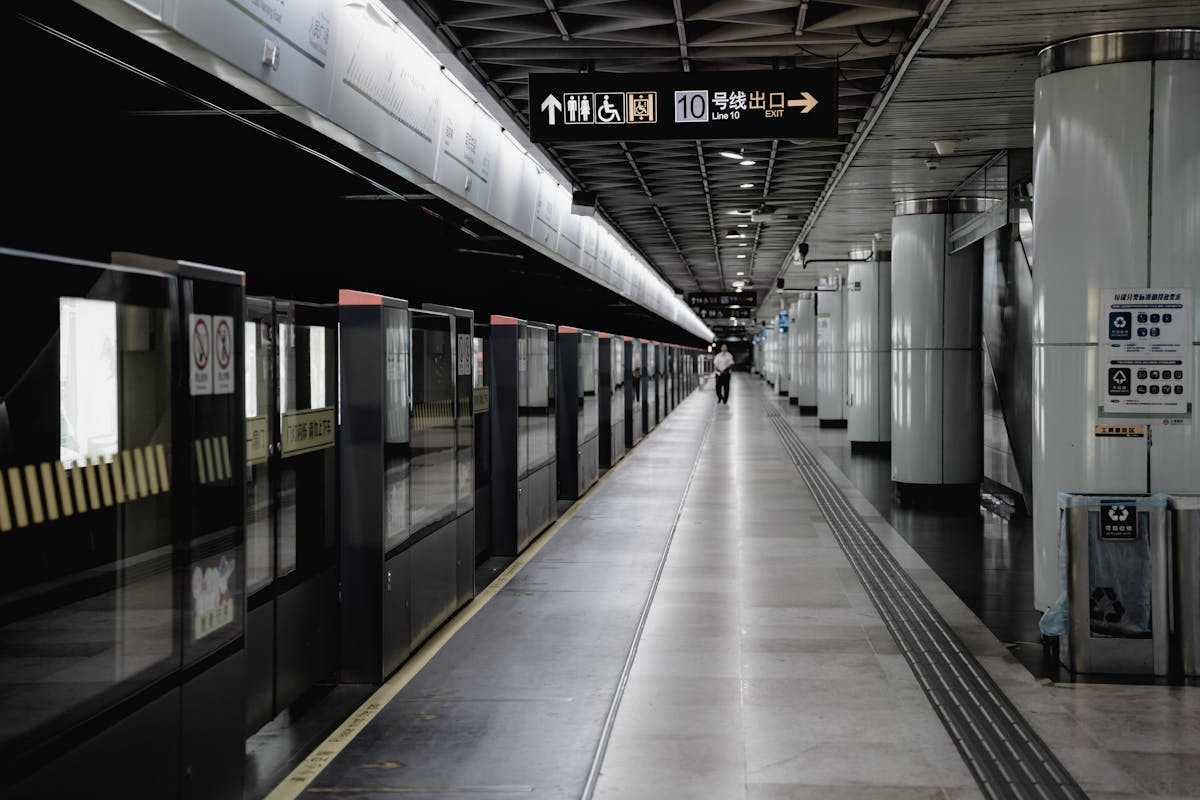
Lines 1 through 18 run beneath central Shanghai, with Lines 16 and 17 reaching out toward the far suburbs and Lines 5 and 8 extending to the southern districts of Minhang and Pujiang. Line 2 — the spine of the city — connects Pudong International Airport in the east to Hongqiao Railway Station and Hongqiao Airport in the west, passing through Lujiazui, Nanjing East Road, People's Square, and Jing'an Temple along the way. Most travellers will use Line 2 or Line 10 (which threads through Yu Garden, Xintiandi, and the French Concession) more than any of the others.
Operating hours follow a uniform pattern: roughly 05:30 to 22:30 on most lines, with Lines 1 and 2 running until around 23:30 to handle late commuters and airport arrivals. Trains run every two to four minutes during peak hours and every eight to ten minutes late at night. Frequencies are posted in English on platform displays. After 22:30 across most of the network, ride-hail or licensed taxi becomes the only realistic alternative — a structural fact that shapes evening planning more than any other detail of the system.
Sundays run on weekday timetables.
Fares are zone-based and computed by the number of stations passed: ¥3 for the shortest journeys, ¥9 for end-to-end runs across the network. A short hop from People's Square to Jing'an Temple is ¥3; the full ride from PVG to Hongqiao Airport is ¥9, with no need for a separate ticket at the interchange. Day passes are ¥18 and three-day passes ¥45 — both worth considering for visitors planning four or more rides per day.
Every station entrance has a security check. Bags pass through an X-ray scanner, and staff occasionally ask travellers carrying water bottles to take a sip to demonstrate the contents. The check adds about thirty seconds at quiet stations and two to three minutes at the busiest interchanges (People's Square, Lujiazui, Xujiahui) during morning rush.
How payment works
Single-trip contactless cards are sold at machines inside every station. Touch-screens default to Chinese but switch to English with one tap, accept ¥10 and ¥20 notes plus Chinese debit cards, and dispense a small plastic disc that is tapped at entry and dropped into the gate slot at exit. For visitors making one or two rides, this is the simplest method.
Frequent users buy a Shanghai Public Transportation Card (Jiaotong Yikatong, 交通卡) from a manned kiosk for a ¥30 refundable deposit plus topped-up value. It works on Metro, buses, most taxis, and Maglev. Refunds are processed at major stations including People's Square and Shanghai Railway Station.
QR-code payment via Alipay or WeChat Pay is now the dominant local method — residents tap a QR through the gate without touching a card. It requires a Chinese mobile number for setup, which is a barrier for short-stay visitors, though both apps have rolled out tourist modes that link foreign credit cards. Foreign-issued Visa and Mastercard contactless cards are now accepted at the gates of around twelve lines (rolling out gradually since 2024); look for the small contactless symbol next to the gate.
English signage is consistent throughout the network. Station names appear in pinyin and Chinese characters on every sign, on-board announcements run in Mandarin and English (with Japanese added on the airport-bound stretches of Line 2), and platform indicators show transfer lines in colour-coded English. A traveller with no Chinese can navigate end to end without difficulty.
Taxis: the four main fleets
About fifty thousand licensed taxis operate across Shanghai, split between four large operators identifiable by livery. Dazhong (大众) cars are turquoise. Qiangsheng (强生) cars are yellow. Bashi (巴士) cars are white. Jinjiang (锦江) cars are green-and-white. All four are metered, regulated, and equipped with the same fare structure; the colour is essentially branding.
Base fare is ¥16 for the first 3 kilometres, then ¥3.50 per kilometre. A 50% surcharge applies between 23:00 and 05:00, raising the per-kilometre rate to ¥4.50. Expressway tolls (typically ¥30–40 from PVG, smaller within the city) are added at the end. A standard run from the Bund to Xintiandi is ¥25–35; from People's Square to Pudong's Jin Mao Tower around ¥40–55 depending on traffic.
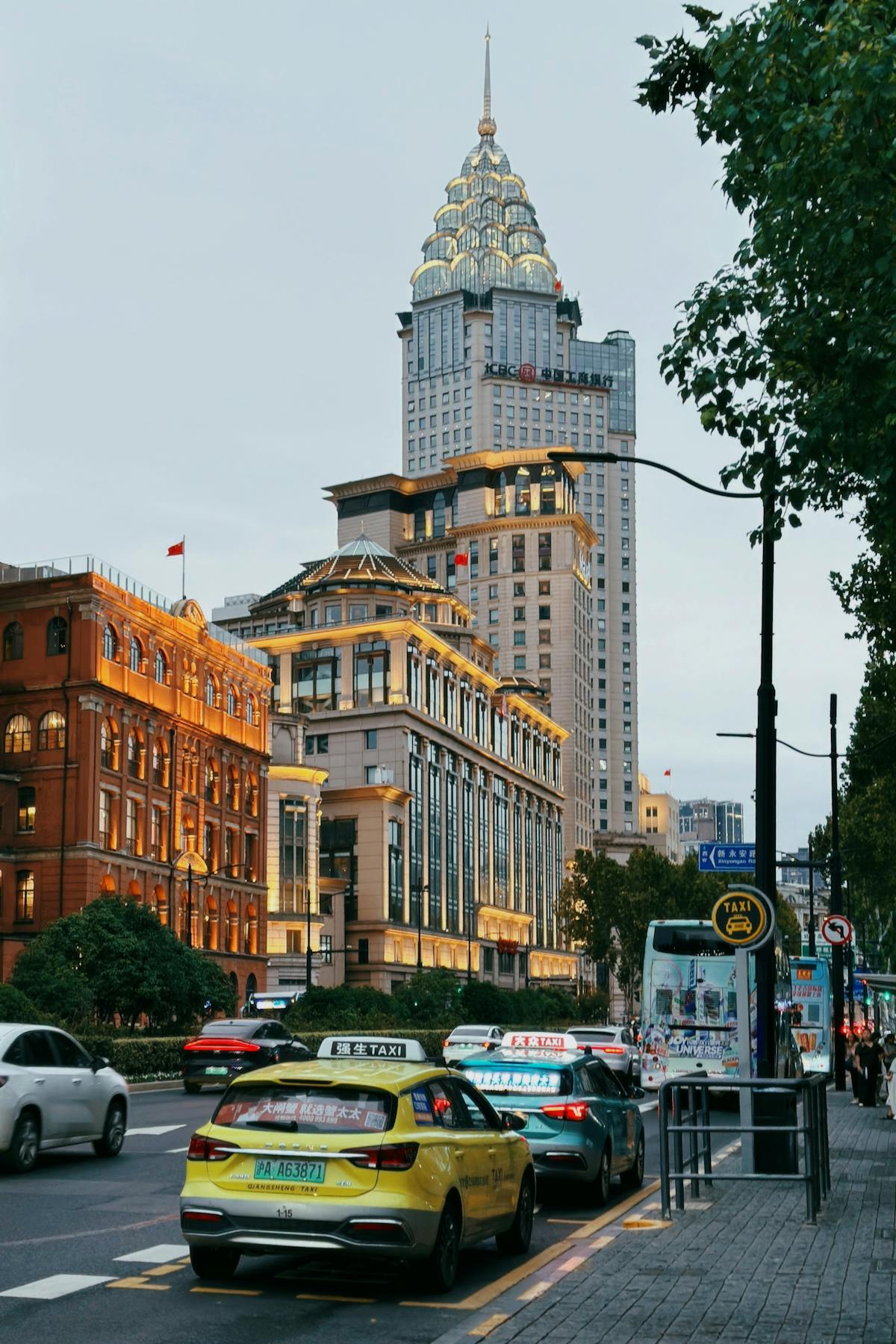
Hailing from the kerb is reliable in central Puxi during the day and at night. It becomes harder during the 08:00–09:30 morning rush and almost impossible during heavy rain — rainstorms in Shanghai compress demand sharply, and most drivers switch to ride-hail platforms during downpours. Outside major hotels and shopping districts, hotel doormen will summon a cab on request, often with a small wait.
Drivers' English is very limited. A written address in Chinese characters works; so does Apple Maps or 高德 (Gaode) on a phone, shown screen-out, with the destination already pinned. Asking for a printed receipt (打的发票, da-di-fapiao) at the end of the ride is worth doing — it carries the taxi number and is the only practical way to recover items left behind.
Avoid the touts
Unmarked private cars at airports, railway stations and tourist sites offer "taxi service" at fixed prices that are typically two to three times the metered fare. Licensed taxis are always at a marked rank with a dispatcher in fluorescent vest, and always run the meter. If a driver refuses to use the meter, walk away.
DiDi for foreigners
DiDi (滴滴出行) is the dominant ride-hail platform in China and the closest equivalent to Uber. It works the same way: open the app, set pickup and drop-off, watch a driver arrive on a map, pay through the app at the end. Most journeys cost ¥10–40 within central Shanghai depending on distance — DiDi Express runs roughly ¥10 base plus ¥2 per kilometre, slightly cheaper than a metered taxi for medium-distance rides.
For years the app required a Chinese phone number and a Chinese bank-linked payment method, which excluded most short-stay visitors. That has changed.
DiDi's international app now offers a foreigner-friendly version in Shanghai that accepts foreign-issued Visa and Mastercard credit cards and uses an international phone number for verification. The interface is in English. Pickup points at airports — particularly PVG — are now designated zones rather than the kerb; signs marked "Online Ride-hail" (网约车) direct passengers to the right level. A traveller without local payment apps can now book a ride start to finish.
DiDi Premier (黑车, the "black car" tier) costs roughly twice DiDi Express. Drivers in this tier are more often able to communicate in basic English and the cars are larger sedans suitable for three or four passengers with luggage. For airport runs, evening returns from outlying districts, or any journey where a metered taxi might be hard to find, DiDi Premier removes the friction without crossing into pre-booked-transfer pricing.
Shanghai is a Metro-first city; everything else is the residual.
Buses, bikes and ferries
City buses cover routes that the Metro doesn't reach and run more frequently than visitors expect — every five to ten minutes on major lines. A flat ¥2 fare applies. The catch is signage: bus stops display routes in Chinese only, on-board announcements are in Mandarin, and route maps inside the bus are not translated. For visitors without Chinese, buses are workable only with a navigation app open and tracking the route in real time.
Rental bicycles are everywhere. Hellobike (yellow) and Meituan Bike (also yellow, sometimes orange) park along most pavements and unlock by scanning a QR code on the handlebar. Both apps require setup with a local phone number or a tourist account through Alipay. A 30-minute ride costs ¥1.50; a day pass ¥3. Cycle lanes exist on most major roads, though the etiquette is closer to "weave with the flow" than to anything resembling Northern European cycle infrastructure.
The Huangpu River ferry — distinct from the Bund tour boats — runs between several pairs of docks for ¥2 and is a useful crossing when the Metro adds an awkward transfer. Crossings take five to ten minutes. The Dongchang Road–Jinling Road East run between Pudong's riverfront and the southern Bund is the most useful for visitors.
Walking distances vary sharply by district. The French Concession, the Bund, Tianzifang, and the old town around Yu Garden are walkable in their entirety. Central Pudong is not — distances between Lujiazui towers, the Oriental Pearl, the World Financial Centre and the riverfront are deceptively long, and the walkways are designed for vehicles rather than pedestrians. Plan for a Metro stop or a short DiDi between Pudong sights even when they look close on a map.
A practical synthesis
For most visitors the working pattern looks like this: Metro for any journey over a kilometre, walking for everything within Tianzifang, the French Concession, the old town, or a single Bund block; a taxi or DiDi only when carrying luggage, when caught in a downpour, or after the Metro stops at 22:30. A typical three-day visit will involve eight to twelve Metro rides, one or two taxi or DiDi journeys, and a great deal of walking.
Day passes (¥18) repay themselves at four rides; three-day passes (¥45) repay at ten.
Late arrivals at PVG complicate this. After the Metro and Maglev shut down around 22:30, options compress to a metered taxi (subject to the 50% night surcharge after 23:00), a DiDi, or a pre-booked private transfer arranged in advance. The last is covered separately in the Pudong airport transfer entry, which weighs the five real options end to end.
For non-Metro reading on the network itself, Shanghai Metro's official service portal publishes English-language line maps, fare calculators, and service alerts. The municipal government's English portal covers transit policy and bus reorganisations, and Britannica's Shanghai article situates the network in the city's longer history of growth.
Onward, the Metro lines that matter most for visitors run through the entries collected here: the Bund on Line 2 at Nanjing East Road, the Pudong skyline towers at Lujiazui (Line 2) and Dongchang Road (Line 2/14), and the French Concession via Shaanxi South Road on Lines 1, 10 and 12.