On 6 April 1849, the French consul Charles de Montigny secured a parcel of land north of the old walled city — 66 hectares of paddy and creek, set aside for French residence and trade. Two later expansions, in 1899 and 1914, pushed the boundary west into what had been farmland and cemetery, until the concession reached its final shape: roughly 8 square kilometres bounded by Avenue Joffre, Rue Lafayette, Avenue Haig, and the Boulevard de Montigny.
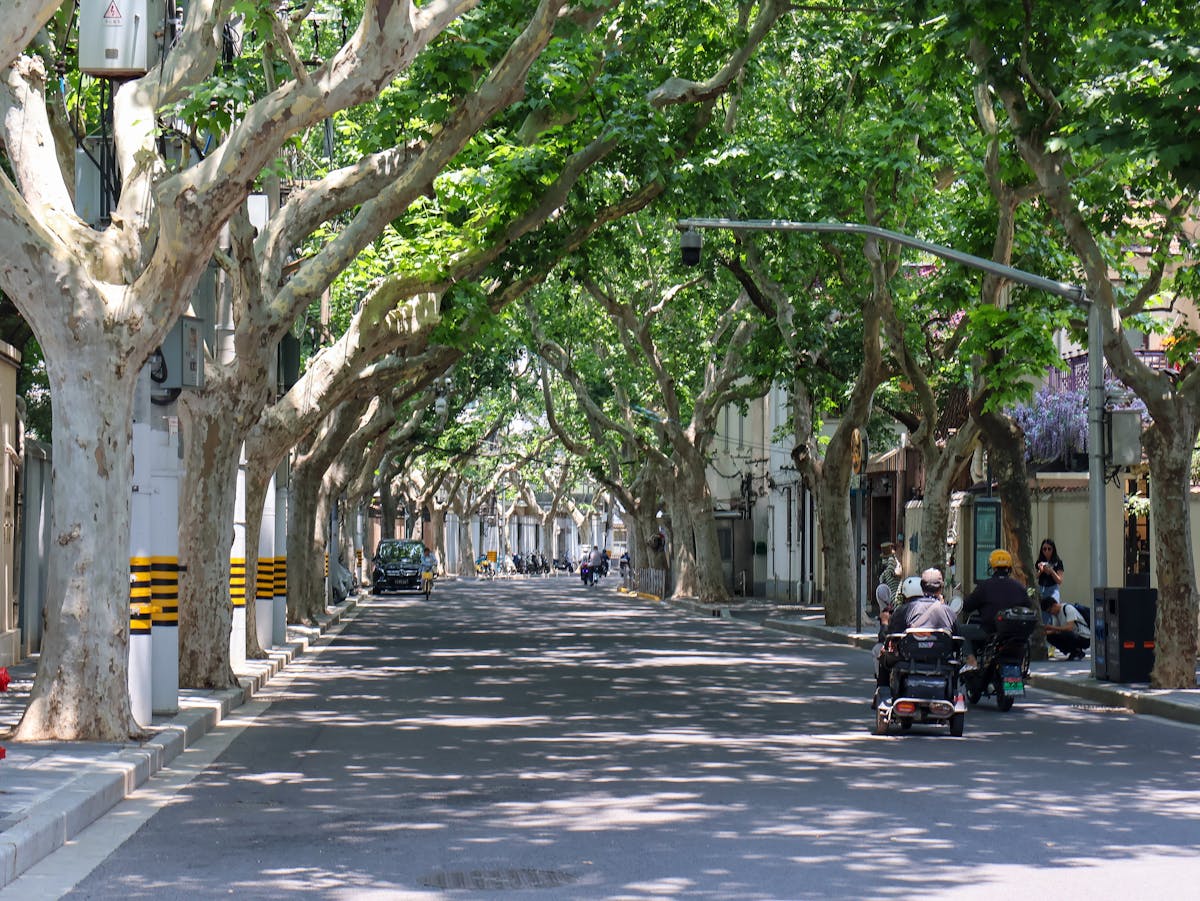
That rectangle sits today across two administrative districts — most of it Xuhui, a small eastern strip Huangpu. Although the political fact of foreign concession ended with the Vichy government's handover to Wang Jingwei's collaborationist regime in 1943, the urban fabric outlasted it. Plane trees planted in the 1920s and 1930s still arch over the main avenues; lane-house compounds built between 1860 and 1940 still stand behind their stone gateways.
Where the boundary runs
Modern street names obscure the colonial layout but a few correspondences are stable. Avenue Joffre is now Huaihai Middle Road, the quarter's main commercial artery. Rue Lafayette is Fuxing Middle Road, quieter and more residential. Avenue Pétain is Hengshan Road. Avenue Haig is Huashan Road. Route Vallon is Nanchang Road.
Walking the area, those names matter mainly because older streets — Wukang, Anfu, Wulumuqi Middle, Yongjia, Xinhua — preserve the original concession scale: narrow, two-lane, lined with trees and three-to-five-storey buildings rather than the tower-and-podium typology that dominates most of Shanghai. A useful rule of thumb on foot: if trees meet overhead and the buildings are no taller than the trees, the road predates 1949.
Plane trees and shikumen
The London plane (Platanus × acerifolia) is not native to Shanghai. French municipal authorities began planting it along concession avenues in the 1860s, with major rounds in the 1920s and 1930s under the Conseil Municipal Français. A small number of those original specimens — identifiable by massive girth and gnarled lower trunks — survive on Shaoxing Road, Sinan Road and the upper end of Wukang Road. Most trees seen today are second-generation, planted in the 1950s and 1960s as the original cohort aged out.
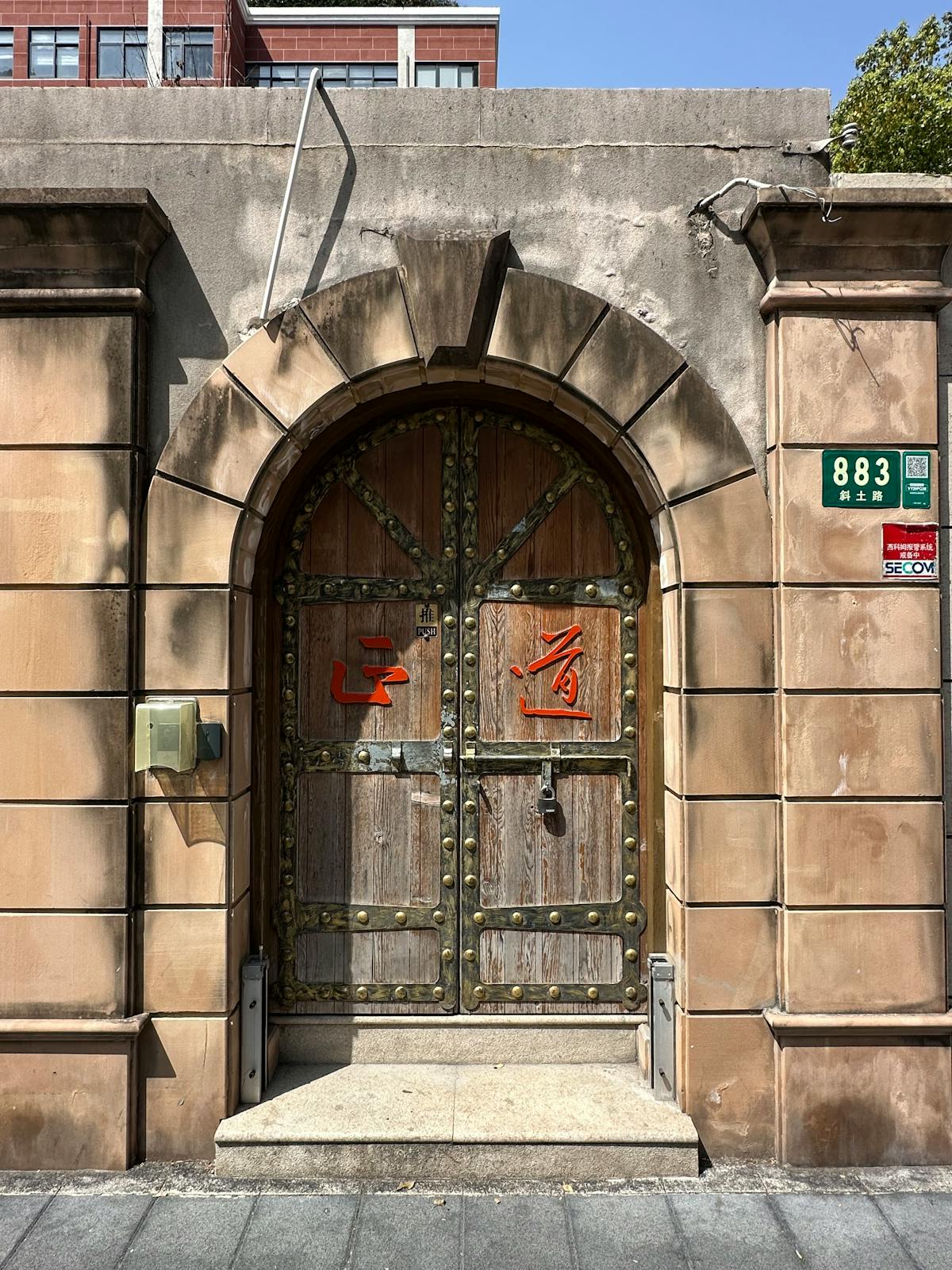
Shikumen (石库门, "stone gate") is the residential typology that fills most of the concession's lane fabric. It developed from the 1860s onward as a hybrid: a Chinese courtyard compound rotated and compressed onto a Western terrace-house street frontage. Each unit has its own stone gateway, often topped with a carved lintel; behind the gate, a small open-air courtyard (天井, tianjing) leads into a two- or three-storey house with rooms organised around a central staircase. Lanes (弄堂, longtang) of forty to a hundred such units, sharing a single entrance from the main road, became the dominant middle-class housing form in pre-war Shanghai.
Estimates put the surviving shikumen stock in the concession area at roughly 200 lanes containing perhaps 30,000 individual units, many still occupied; others converted to cafés, bars, design studios, or — at the Xintiandi block — wholesale commercial development.
Practical note
Shikumen Open House Museum at Xintiandi (北里 Lane 181, Taicang Road) shows a restored shikumen interior across two floors — kitchen, courtyard, parents' bedroom, attic. Admission ¥30, open 10:30–22:30 daily. It is the only place in the city where a non-resident can walk through a complete shikumen unit.
An afternoon's walking route
A reasonable three-hour loop begins at Hengshan Road metro station (Line 1/7) and works east. Start north on Hengshan Road itself, turn right onto Yongjia Road for two blocks, then left onto Wulumuqi Middle Road. At the junction with Wuyuan Road, turn right; Wuyuan Road is a representative concession side street — three to five storeys, plane trees, scattered cafés and small shops in former shikumen units.
Continue east on Wuyuan, cross Changshu Road, and turn left onto Anfu Road, the quarter's most concentrated café strip with roughly 80 independent businesses on a 1.2-kilometre stretch. From the eastern end of Anfu, jog south one block to Wukang Road, then walk south along Wukang to the Wukang Mansion building at the junction with Huaihai Middle Road. Fifteen minutes further east along Huaihai brings the walk to Sinan Road, where the 1922 Soong Ching-ling Residence (¥20) and the 1932 Sun Yat-sen Residence (¥20, both open 09:00–17:00) bracket the south side of Fuxing Park.
Art Deco landmarks
Shanghai held one of the world's largest concentrations of Art Deco buildings between 1925 and 1937, and a meaningful share of them stand inside the former concession. Three are worth noting on any walk.
- Wukang Mansion (武康大楼, 1924). Originally the Normandie Apartments, designed by László Hudec for the International Savings Society. Eight storeys, brick-and-stucco, wedge-shaped to fit the awkward six-way junction at Wukang Road and Huaihai Middle Road. Restored in 2010. Address: 1850 Huaihai Middle Road.
- Cathay Theatre (国泰电影院, 1932). Art Deco cinema, also Hudec, on Huaihai Middle Road at Maoming South Road. Still operates as a cinema; the lobby retains most of its original 1932 fittings.
- Former Soviet Consulate (1916). 20 Huangpu Road in the eastern strip. Russian neoclassical with Art Nouveau detailing rather than strict Deco, but representative of the consular architecture that filled the concession's eastern end.
A useful free reference for further building-by-building information is shanghai.gov.cn, which maintains a registry of protected historic structures with addresses and construction dates.
Cafés, shops, restaurants
Retail in the quarter clusters along three streets: Anfu Road (cafés, small bakeries, wine bars), Wukang Road (independent fashion boutiques, design shops), and Yongkang Road (smaller bars, more local-leaning bistros). Prices run higher than the city baseline — a flat white at ¥38–48 against a citywide average of ¥28 — with a customer mix on most weekday afternoons roughly half Shanghainese, half international resident. Restaurants tend to favour smaller-format independent operators rather than chain or hotel dining; reservations are advisable on Friday and Saturday evenings.
Best timing and access
Two windows in the year are notably better than the rest. Mid-April through late May, plane trees come into full leaf and temperatures settle between 18°C and 24°C; magnolias and wisteria flower in early April on several side streets. Mid-October through late November returns the leaves to gold before they drop, with daytime temperatures of 14°C to 20°C and the lowest rainfall of the year. Summer (July, August) is humid and frequently above 35°C; winter (December–February) sees the trees bare and side streets dim by 17:00.
Four metro stations serve the area: Hengshan Road (Line 1/7) for the western and central concession; Shanghai Library (Line 10) for Wukang Road–Anfu Road; Xinhua Road (Line 13) for the southwest extension; and South Shaanxi Road (Line 1/10/12) for the eastern end near Fuxing Park. Walking remains the only sensible mode within the quarter.
For nearby complementary sights, see Tianzifang, a converted shikumen lane block at the concession's southern edge, and the Bund for the contemporaneous waterfront. Jing'an Temple sits just outside the historic boundary at the northwestern corner; getting around Shanghai covers metro and taxi mechanics. Background reading on the wider treaty-port era is at britannica.com; current visitor information at meet-in-shanghai.net.