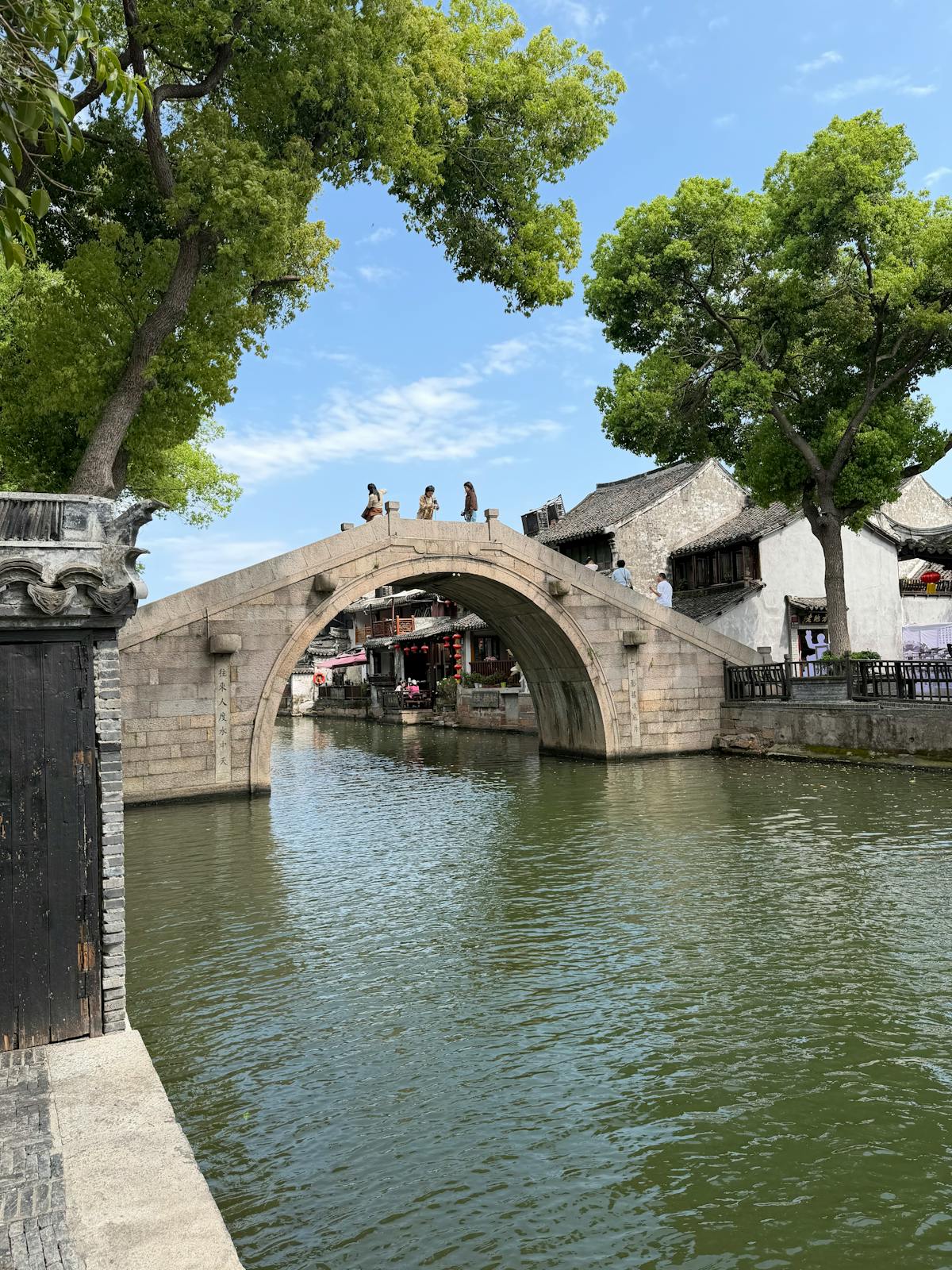
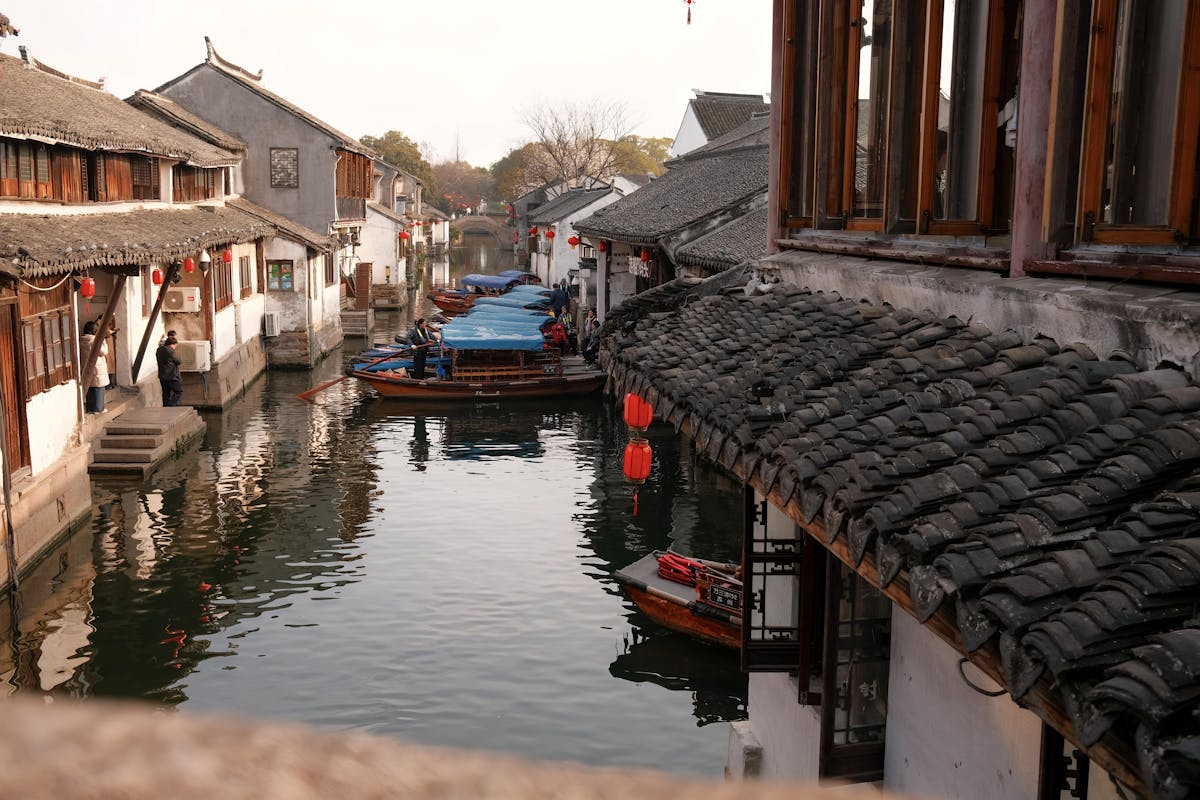
Fangsheng Bridge, a 70-metre five-arched span finished in 1571, is the largest stone bridge in Zhujiajiao and the visual anchor of the town. Walk its uneven granite steps and the canal opens up on both sides — narrow black-tiled houses, willows brushing the rooflines, wooden boats tied to mossy posts. Roughly 50 kilometres west of People's Square, in Qingpu District, Zhujiajiao sat historically as a port on the Caogang Canal, which carried rice and silk between the Yangtze Delta and imperial granaries upriver.
Records mention a settlement here as early as the Han and Three Kingdoms era (about 1,700 years ago); surviving architecture is overwhelmingly Ming and Qing (1368–1911). Nine main canals divide the old town into a grid of small islands, linked by 36 stone bridges. Entry to the town itself is free; tickets cover only specific attractions.
An hour west
Zhujiajiao sits at the western edge of municipal Shanghai, about 50 kilometres from People's Square along the G50 expressway. Roughly two kilometres across end to end, everything inside it can be covered on foot in a half-day. A smaller share of visitors arrive from Suzhou or Hangzhou as part of a Yangtze Delta water-towns route covered by Britannica.
Compared to Wuzhen, Tongli, or Xitang further out, Zhujiajiao trades postcard perfection for accessibility — the only one of the majors reachable on a single ¥17 city bus from central Shanghai.
Bridges and canals
Of the 36 stone bridges, three carry most of the visitor traffic and most of the photographs.
Fangsheng Bridge ("Setting Free Bridge", 1571) is the showpiece — five arches, 70 metres long, granite blocks fitted without mortar, with a centre arch high enough for wooden barges to pass beneath. Its name comes from the Buddhist tradition of releasing captive fish from the bridge as a merit-making act, still occasionally observed.
Langqiao, the "Veranda Bridge", is the only covered span in the town — a wooden roof on red-painted timber posts, benches set along the sides for traders waiting out the rain.
Tai'an Bridge, a Qing-dynasty stone arch with carved railings, sits on a quieter side canal — the better of the three for architectural detail.
Smaller spans link almost every block, many no more than five metres long.
A note on the canal grid
Jiangnan ("south of the Yangtze") water towns share a recognisable layout: parallel canals running roughly north-south, smaller cross-canals east-west, stone bridges at every junction. Zhujiajiao's nine main canals follow this pattern, with the broadest — Caogang — running through the middle. Houses face water on one side and a stone-paved lane on the other.
Pharmacy, post office, garden
Four buildings beyond the bridges are worth specific attention, each opened as a small museum.
Kezhi Garden (1912) is the largest enclosed attraction — a five-acre estate built as a private mansion in the late Qing transition years. Its name translates as "Garden of Diligence and Restraint"; grounds combine a traditional Chinese garden (rockeries, lotus ponds, a five-storey pavilion) with Western architectural fragments in the main house.
Yuanjin Buddhist Temple, Ming in origin and substantially rebuilt, remains an active monastery. Robed monks conduct services on most mornings; a low admission applies to the main halls.
Tongtianhe Pharmacy is a Qing-era traditional Chinese medicine shop with much of its original interior — wooden drawers labelled in classical Chinese for ginseng, dried tangerine peel, deer antler, plus a long counter with brass scales and an upstairs consultation hall.
Daqing Post Office, founded in the late Qing, is the oldest surviving post office in the wider Shanghai region — original red postboxes, brass postage scales, stamped letter-trays.
Tickets and access
Two ticket combinations are sold at booths near the main entrances:
| Ticket | Price | What's included |
|---|---|---|
| Combo (full) | ¥60 | Entry to 9 attractions: Kezhi Garden, Yuanjin Temple, Daqing Post Office, Tongtianhe Pharmacy, plus 5 smaller halls and exhibits |
| Combo (select) | ¥30 | Entry to 4 selected attractions, chosen from the same list |
| Town entry | Free | The streets, canals, all 36 bridges, all shops and restaurants |
For an afternoon visit, the ¥30 select ticket is generally enough — Kezhi Garden alone justifies it. The ¥60 full combo makes sense for a full-day stay.
Access from central Shanghai falls into three brackets. Most economical: the Hu-Zhu Express bus (沪朱高速快线) from People's Square — boarding stops near East Yan'an Road and Pudian Road metro station — running the 50 kilometres in roughly 70 minutes for ¥17 one-way. A second option: the Shanghai Tour Bus from Shanghai Stadium, more expensive and more touristy. Third: organised day tours from major hotels, typically from ¥350 per person including return transport and a guide. Onward transit notes are covered in getting around Shanghai.
Riding the canals
Wooden gondola-style boats wait at numbered jetties along Caogang and the side canals. Each carries up to six passengers on a 30-minute loop, passing under Fangsheng, Langqiao, and several smaller spans. Fare is ¥150 per boat (not per person) — a group of six pays ¥25 each, a solo rider the full ¥150 unless willing to share.
Worth considering for two reasons. Canal-house architecture reads differently from water level: eaves and water-stained foundations come into clearer view. Second, rowers (almost all local women in their fifties and sixties) sing folk songs on request, in a Jiangnan boating dialect largely vanished elsewhere.
The boats are tourism, but the songs are not.
Operating hours: roughly 08:30 to 16:30, longer queues on weekends.
Weekdays vs weekends
Zhujiajiao's accessibility cuts both ways. On weekends and Chinese public holidays, foot traffic on North Street can be heavy enough that bridges back up and photography becomes a queue-management exercise. Weekdays are noticeably calmer; a Tuesday or Wednesday morning may find half the bridges nearly empty.
Best months: April through June and September through October — mild temperatures, low rain, willows at their fullest. July and August are humid and hot; January and February are damp and cold but offer the lowest visitor numbers of the year.
Most visitors on the main streets are tourists, and canal-side restaurants on North Street price accordingly. For a meal closer to local rates, walk five minutes inland to an unsigned noodle shop on the residential lanes — official lists at visitshanghai.com.cn, heritage notes at UNESCO tentative listings and china.org.cn.